How to
Sow a cover crop
The tomatoes are out and the bed will sit bare until spring. It's late for most covers, but cereal rye still goes in, and it holds the soil all winter.
Grown in Ohio, zone 6a. Your frost dates move the calendar; the signals don't. Broadfork goes by where your garden is, not its zone: frost dates for your ZIP code in the US, or the ones you type in anywhere else.
Five minutes to read. The steps stand on their own.
Before you start#
Pick the cover for the job. Oats and rye build organic matter and hold the soil; clover and vetch add nitrogen; radish breaks up packed ground with its taproot; buckwheat smothers weeds in a summer gap.
Then pick by the winter. Oats and radish die over most winters and leave their residue on the bed. Rye, wheat and vetch come through, and you end them in spring.
Too late for any of these? Cover the soil with mulch instead.
- Oats
- The beginner's crop: organic matter, looser soil, weeds held down. Sown 40 to 60 days before the first killing frost, it dies over most winters into a thick mulch. Most sources say 2 to 5 oz of seed per 100 square feet; one says 4 lb per 1,000, a heavier rate.
- Cereal rye
- The toughest: it holds down weeds, builds organic matter, soaks up more leftover nitrogen than any other, and its deep roots work into clay. It sprouts in soil as cold as 34 or 35 °F, so it can go in last, into mid or late October. Most sources say 2 to 5 oz per 100 square feet; one says 4 lb per 1,000, a heavier rate.
- Winter wheat
- Does rye's job and is easier to end in spring. It goes in at the same time, mid to late October.
- Crimson clover
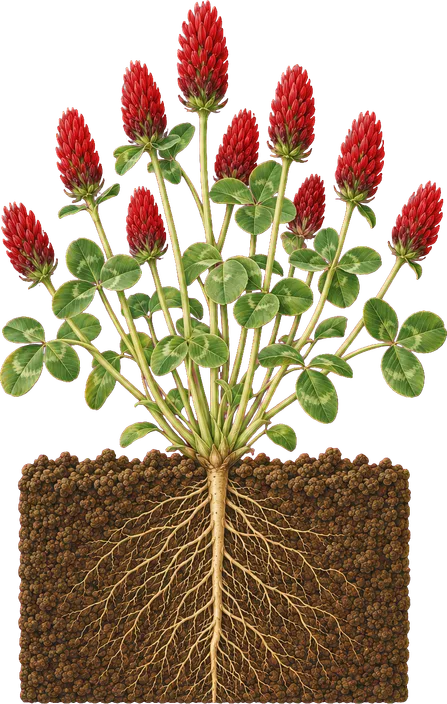
- Nitrogen, and a spring bloom for the bees. Sow it 6 to 8 weeks before the first frost, 0.4 to 2 oz per 100 square feet. Whether it lives through the winter depends on the variety, so count it as one that may not.
- Hairy vetch
- Nitrogen and weed control, and hardy through hard winters. Sow it 30 to 45 days before the killing frost, 0.5 to 4 oz per 100 square feet. Its vines tangle, so it's hard to end.
- Radish
- Its taproot breaks up packed soil, and it soaks up leftover nitrogen. Sow it about 4 weeks before the first 28 °F freeze; it dies below 23 to 25 °F. 0.2 to 2 oz per 100 square feet.
- Buckwheat
- The summer gap filler: it smothers weeds, loosens the topsoil and feeds the bees, and it flowers within 3 weeks. Frost kills it. 2 to 4 oz per 100 square feet; one source doubles its 2 oz to smother weeds.
The steps#
- Broadcast the seed over the bed. Every rate here is seed scattered by weight over the ground, not sown in rows.
- Sow by the frost, not the calendar. Count back from your fall frost dates: 6 to 8 weeks before the first frost for clover, 40 to 60 days before the first killing frost for oats, 30 to 45 days before the killing frost for vetch, about 4 weeks before the first 28 °F freeze for radish. Rye and wheat go in last.
- Let the winter end the tender ones. Oats and radish die over most winters. Turn the residue under in spring.
- End the rest at least 2 to 3 weeks before you plant. Turn it under or mow it. Rye has to go before it matures: turn it under at 10 to 12 inches tall, or mow it at flowering. After late May it's a fight.
- End clover and vetch at bloom. Mow, crimp or turn vetch under at about 50 percent bloom, before it ripens seed. Clover dies if you mow it after its early buds, or turn it under at bloom.
- Kill buckwheat 7 to 10 days after it starts to flower. Before the seed hardens, or it reseeds.
Short season In zone 5 and colder, count crimson clover as one that dies over winter. Hairy vetch still comes through.
Mild winter Where winters are milder, crimson clover often lives through.
In Broadfork In Broadfork a cover crop is a planting broadcast over a bed's squares, with no harvest, and its crop page lists when to sow it and when to end it.
If it goes wrong#
- Rye too big to turn under
- It went past flowering. Next year, end it at 10 to 12 inches tall.
- Buckwheat or ryegrass came back as weeds
- They went to seed. Kill buckwheat before the seed hardens, and ryegrass at early bloom.
- Vetch wrapped around the tiller
- It tangles. Mow it or crimp it.
- No clover left in spring
- How well it winters depends on the variety. Count it as a cover that may not make it.
- A rotten smell in spring
- Radish residue as it rots. Turn it under.
Every number on this page comes from a published extension source.
Sources for this guide: Ohio State University Extension, University of New Hampshire Extension, Clemson Cooperative Extension, Iowa State University Extension and Outreach, Penn State Extension, SARE, University of Maryland Extension, Virginia Cooperative Extension.
The documents behind this guide (11)
- Cover Crops in the Garden (2023), Ohio State University Extension
- Crimson Clover as a Cover Crop in Ohio (2023), Ohio State University Extension
- Oats as a Cover Crop in Ohio (2023), Ohio State University Extension
- Cover Cropping for the Home Garden (2026), University of New Hampshire Extension
- Fall Vegetable Garden Activities (2000), University of New Hampshire Extension
- Cover Crops (2017), Clemson Cooperative Extension
- Types of Cover Crops for Use in Home Vegetable Gardens (2026), Iowa State University Extension and Outreach
- Tips for Planting Cover Crops in Home Gardens (2026), Penn State Extension
- Managing Cover Crops Profitably, SARE
- Cover Crops For Gardens (2026), University of Maryland Extension
- Mulching: Purpose, Benefits, and Essential Information (2025), Virginia Cooperative Extension
Updated 11/10/2026 · Checked against our sources 11/12/2026