
Crop guide
Lettuce
Lettuce wants the cool ends of the year. Sow it in early spring and again in late summer, a short row at a time, and pick it before the heat makes it bolt.
Grown in Ohio, zone 6a. Your frost dates move the calendar; the signals don't. Broadfork goes by where your garden is, not its zone: frost dates for your ZIP code in the US, or the ones you type in anywhere else.
Twelve minutes to read. Each section stands on its own.
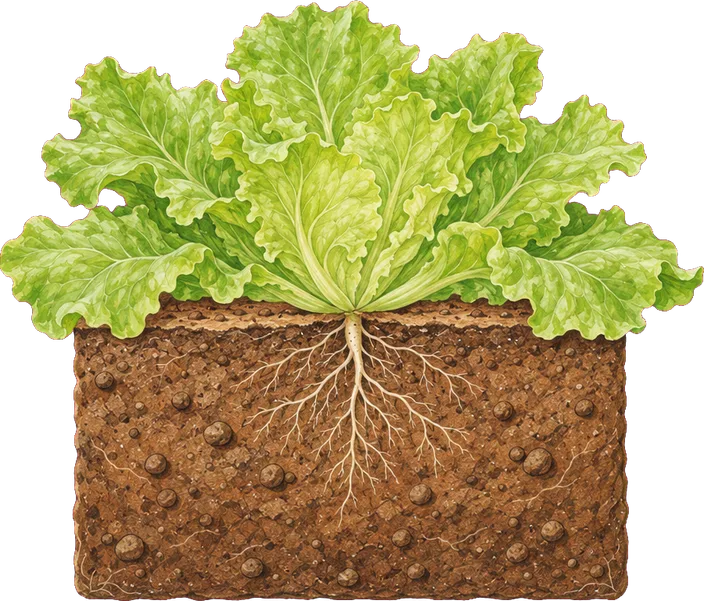
- What you plant
- Seed or transplants. Leaf lettuce is easiest from seed sown in the bed; head lettuce does best from transplants.
- When
- Early spring, once the soil reaches 40 °F, about 2 to 3 weeks before the last frost. Again in late summer, about three months before the first fall frost. Here, leaf lettuce is sown from April 1, and for fall on August 1.
- How deep
- 1/8 to 1/2 inch. The seed needs light to sprout, so keep it shallow.
- How far apart
- Leaf lettuce 4 to 6 inches, or 10 to 12 for full-size plants. Crisphead 10 to 12; butterhead and romaine 6 to 8, and the data runs to 12. Rows 12 to 18 inches apart; the data runs to 3 feet. The app plants four to a square foot, 6 inches apart.
- Sun and soil
- Full sun, at least 6 hours; the data runs from 3 or 4 hours for a summer planting to 10. Part shade helps once it turns hot. Loose, fertile soil that drains, with plenty of organic matter, kept moist.
- Frost
- Semi-hardy in the app's catalog: it takes a light frost, and hardened transplants can survive 20 °F. Seedlings take more cold than full-grown plants.
- Family
- Asteraceae, the aster family, with endive, radicchio, salsify, sunchoke and artichoke, and ten of the fifteen flowers in the app's catalog.
- Harvest
- Leaf lettuce from about 4 weeks, full size in 45 to 60 days; the figure given here is 40 to 50. Butterhead and romaine take about 55 to 75 days, crisphead 75 or more, cut once the head is firm.
- Soil pH
- 6.0 to 6.8, and never below 6.0: lime soil that tests lower. Some sources stop at 6.5, others go up to 8.0.
- winterStart transplants indoors, 3 to 6 weeks before they go out.
- springFirst sowing once the soil reaches 40 °F, 2 to 3 weeks before the last frost.
- springSow a short row again every week or two, and pick until the heat comes.
- summerSeveral days over 75 °F and it can bolt.
- summerSow for fall, about three months before the first frost.
- fallPick through the light frosts.
Planting#
Leaf lettuce goes in as seed, straight into the bed. Head lettuce does best from transplants set out in early spring, because a crisphead needs a long cool run to make its head before the heat.
Sow once the soil reaches 40 °F, about 2 to 3 weeks before the last frost, 1/8 to 1/2 inch deep. The seed needs light to sprout, so cover it thinly and firm it.
It comes up in 7 to 14 days, faster in warm soil: about a week at 50 °F, 2 days at 70. The best range runs from 55 to 65 °F in one source to 68 to 77 in another, and it sprouts poorly in heat: the data puts the line anywhere from 77 °F to 86, and seed can go dormant when it's hot.
Sow about 10 seeds to the foot and thin once the seedlings have 3 or 4 true leaves: leaf lettuce to 4 to 6 inches, butterhead and romaine to 6 to 8, crisphead to 10 to 12. The thinnings can be moved to another spot if the roots come with them.
Start transplants indoors 3 to 6 weeks before they go out; the data runs from 3 to 4 weeks to 5 or 6. Sources that count from the frost instead start them 4 to 8 weeks before the last frost. One table gives head lettuce 10 to 11 weeks, and a cold frame takes 10 to 12. Harden them off for 3 to 5 days first, with less water and cooler air; the data runs to 10. Set them out with 4 to 6 true leaves.
When they go out, the data splits: 3 to 4 weeks before the last frost, or close to the frost date itself.
Sow a short row every week or two rather than one long one, so the lettuce comes on a little at a time; the data runs to every 3 weeks. For how much: 5 to 10 feet of row per person, or about 3 feet sown again and again through the season.
For a fall crop, sow about three months before the first fall frost, or start seed indoors in July and set the plants out in August. The date given here for leaf lettuce is August 1.
A sowing made in summer heat comes up better in shade: 50 percent shade cloth, or two layers of row cover, until the plants have about six leaves.
In Broadfork On a lettuce row, Plant again opens the add form for the same lettuce, dated two weeks on, our default interval.
Short season Where the season is short, the first sowing goes in as soon as the soil can be worked, often in April, with transplants out in late April or early May. A row cover gives 4 to 8 °F of protection and moves planting 3 to 4 weeks earlier.
Mild winter Where winters are mild, lettuce grows through the cool months instead: sown from late summer into fall and again in late winter, with winter itself the main season in the warmest places. Count a fall sowing back 10 to 14 weeks from the first freeze, much the same as the three months above.
The season in between#
Lettuce has shallow roots, so keep the soil evenly moist and don't let it dry out: about 1 inch of water a week; the data runs to 2. Uneven water makes tough, bitter leaves, slows heading, and helps set off a bolt.
Water at the soil, not over the leaves, and don't keep the surface wet: a damp surface brings slugs and root disease. The data splits on how much at a time: one source says water deeply, another says light and often. Drip is the easy way.
Work in about 2 pounds of 10-10-10 per 100 square feet before planting, and side-dress once the plants are 4 inches tall, about 1 pound per 25 feet of row. Most of the plant's growth comes in its last few weeks, which is why the feeding is split. The data splits on the side-dressing too: one table gives lettuce none.
A mulch of weed-free straw, or grass clippings with no weed killer on them, holds the water and cools the soil. One source lays it 3 to 4 inches deep; others keep it thin, and where slugs are a problem it should be: 1 inch, and no more than 3.
Lettuce competes poorly with weeds: its roots are shallow and its leaves don't shade much ground. Clear perennial weeds before planting, and hoe early and shallow.
Heat is what ends a lettuce planting. Several days above 75 °F can set it bolting: it sends up a flowering stalk and the leaves turn bitter. Other sources put the line anywhere from 70 to 80 °F, the low end with dry soil. Long days push it along too.
To stretch it into summer, grow a slow-bolting variety for the later sowings, give it afternoon shade from taller plants or a shade cloth, and keep the water even. In one trial, a 30 percent shade cloth on a 90 °F day cooled the leaves from 82 °F to 75 and gave the least bitter lettuce.
Mild winter Where winters are mild, winter is the season. The advice from the warmest places is to cover it with a frost blanket below 40 °F and give it afternoon shade above 85.
Harvest#
Pick leaf lettuce a leaf at a time, the older outer ones first, as soon as they're big enough to use, and the center keeps growing. Or cut the whole plant at the soil once the leaves are 4 to 6 inches long.
Cut close to the soil, leaf lettuce grows back for a second cutting in 2 to 3 weeks; the data runs to 4, and sometimes there's a third. A head cut an inch above the roots may regrow too, less tender.
Cut a crisphead when the head is firm and gives a little when pressed; butterhead and romaine as the heads start to form, or any time before. A romaine is ready as a partly tight head 6 to 8 inches tall. Take heads before the heat, a bolt or a freeze gets them.
Cut a head with a sharp knife just below the lowest leaf. Where plants are crowded, cut every other one and the rest grow on into the room.
In Broadfork Log Bolted on a lettuce planting and its bar's picking ends that day; the planting keeps its ground until you clear it.
Short season Where fall comes early, time a fall crop to be ready 1 to 2 weeks before the first frost: a full-grown plant takes a freeze worse than a seedling does. A row cover put on in September keeps it going later into fall.
Short season Lettuce is hard to carry through the winter, even under a tunnel. Under one, a sowing in mid-September can still be picked until the end of December.
Storing#
Lettuce keeps best cold, 32 to 36 °F, in damp air. In a bag in the crisper it keeps a week or two; the data runs from three days to four weeks, and lettuce bagged dry keeps longest.
Chill it as soon as it's picked. The data splits on washing: one source says store it unwashed, another rinses it and chills it at once.
Keep it away from ripening apples, pears and tomatoes.
Lettuce doesn't freeze, and it doesn't keep long. Small sowings, often, are how to have it fresh.
Lettuce that turned bitter in the heat gets milder after a day or two washed and in the refrigerator.
Which lettuce#
Five kinds. Leaf lettuce is the quickest and easiest. Butterhead makes the loose Bibb and Boston heads. Romaine grows tall and upright. Summer crisp sits between butterhead and crisphead. Crisphead, the iceberg type, is the hardest: it needs a long cool season and bolts quickly under stress.
For the sowings that run toward summer, romaine holds best: it takes warm weather and is slower to bolt than the others.
Choose a slow-bolting variety for the later sowings. The data names Jericho, a romaine, as heat tolerant, and New Red Fire and Buttercrunch as bolt resistant.
In the app's catalog, among others: Black Seeded Simpson, Buttercrunch, Parris Island Romaine, Red Sails, Salad Bowl, Little Gem and Jericho.
Short season Where the season is short, grow butterhead, Bibb and romaine for heads. Iceberg needs a longer cool season than spring there gives it.
Mild winter Where winters are mild, head lettuce struggles in the heat; leaf lettuce, romaine and Bibb are the ones to grow.
What goes wrong#
- Bolting: a flowering stalk from the center and bitter leaves, and the plant is past picking. Several days above 75 °F, long days and dry soil bring it on. Once a stalk forms, sow again when it's cooler.
- Tipburn: the edges of the inner leaves turn brown. A soaking after a dry spell sends the plant into a growth spurt, and the new leaves can't take up enough calcium. Water evenly; adding calcium to the soil rarely helps.
- Slugs: holes in the leaves, eaten at night. Trap them under boards or wet newspaper and clear the traps in the morning, keep the mulch thin, water in the morning, and use iron phosphate bait if they're bad.
- Aphids: the most common pest on leafy greens, small soft insects under the leaves. A strong spray of water knocks them off, and lady beetles and lacewings eat them. Insecticidal soap if they build up.
- Aster yellows: yellowed, stunted, bitter plants, spread by the aster leafhopper, and there is no cure. A row cover from emergence until about 30 days before harvest keeps the leafhoppers off; clear the weeds at the edges.
- Damping off: seedlings that fall over at the soil line just after they come up. Use fresh seed-starting mix and clean pots, sow shallow and don't overwater. Seedlings that have it can't be saved.
- Bottom rot and drop: the lower leaves of a head rot where they touch the soil, worst in wet ground and in heads that grow slowly. Ground that drains, or a raised bed, room between plants, and a rotation of at least 3 years.
- Cutworms cut young plants off at the base; flea beetles chew small round holes. A row cover keeps flea beetles off the seedlings.
Where it goes next year#
Lettuce shares its family with endive, radicchio, salsify, sunchoke and artichoke, and ten of the fifteen flowers in the app's catalog. Move it each year. To keep bottom rot down, keep the bed out of the crops its fungus attacks for at least 3 years: lettuce, and the cabbage family, where the same fungus causes wirestem. Out of salad greens for at least 4 years keeps damping off down. Keep it away from last year's lettuce, spinach, endive and escarole, and from the cucumber family, which carries a mosaic virus that infects it.
After a cereal rye cover crop, wait a few weeks before sowing lettuce: the rye's residue keeps small seed from coming up. In one trial, only 50 percent of the lettuce came up after rye that was 50 days old when it was ended.
Once the bed is empty, cover the soil rather than leave it bare.
In Broadfork The bed's rotation card counts the rest years for you and says which families are clear to go back in.
Every number on this page comes from a published extension source.
Sources for this guide: University of Minnesota Extension, Ohio State University Extension, Iowa State University Extension and Outreach, Oregon State University Extension, Texas A&M AgriLife Extension, University of California, University of Illinois Extension, University of Wisconsin-Madison Division of Extension, Clemson Cooperative Extension, Cornell Cooperative Extension, NC State Extension, Penn State Extension, Purdue Extension, SDSU Extension, UMass Extension, University of Florida, University of Georgia Extension, University of New Hampshire Extension, Utah State University Extension, Virginia Cooperative Extension.
The documents behind this guide (33)
- Aphids in home yards and gardens (2019), University of Minnesota Extension
- Extending the growing season: start early, end later (2024), University of Minnesota Extension
- Growing lettuce, endive and radicchio in home gardens (2024), University of Minnesota Extension
- How to prevent seedling damping off (2024), University of Minnesota Extension
- Planting vegetables in midsummer for fall harvest (2026), University of Minnesota Extension
- Cover crops in the garden (2023), Ohio State University Extension
- Home Vegetable Gardening (1991), Ohio State University Extension
- Selecting, Storing, and Serving Ohio Greens (2021), Ohio State University Extension
- Slugs and Their Management in Landscapes (2022), Ohio State University Extension
- Growing Leafy Greens in Iowa (2022), Iowa State University Extension and Outreach
- Let Us Grow Lettuce! (2009), Iowa State University Extension and Outreach
- Salad Greens (2020), Oregon State University Extension
- Vegetable Gardening in Oregon (2023), Oregon State University Extension
- Easy Gardening: Mulching (2014), Texas A&M AgriLife Extension
- Texas Home Vegetable Gardening Guide, Texas A&M AgriLife Extension
- Cultural Tips for Growing Lettuce (2026), University of California
- Tipburn, University of California
- Lettuce, University of Illinois Extension
- Put your garden to bed with fall/winter cover crops! (2021), University of Illinois Extension
- Damping Off (2024), University of Wisconsin-Madison Division of Extension
- Growing Salad Greens in Wisconsin (2011), University of Wisconsin-Madison Division of Extension
- Lettuce (2023), Clemson Cooperative Extension
- Lettuce (2006), Cornell Cooperative Extension
- Lactuca sativa, NC State Extension
- Season Extenders and Growing Fall Vegetables (2024), Penn State Extension
- Home Gardener's Guide (2026), Purdue Extension
- Salad Greens: How to Grow It (2024), SDSU Extension
- Vegetable Notes (2025), UMass Extension
- Lettuce, University of Florida
- Home Garden Lettuce (2022), University of Georgia Extension
- Growing Vegetables: When to Plant Your Vegetable Garden, University of New Hampshire Extension
- How to Grow Lettuce in Your Garden (2020), Utah State University Extension
- Mulching: Purpose, Benefits, and Essential Information (2025), Virginia Cooperative Extension
Updated 11/11/2026 · Checked against our sources 11/12/2026