Crop guide
Cabbage
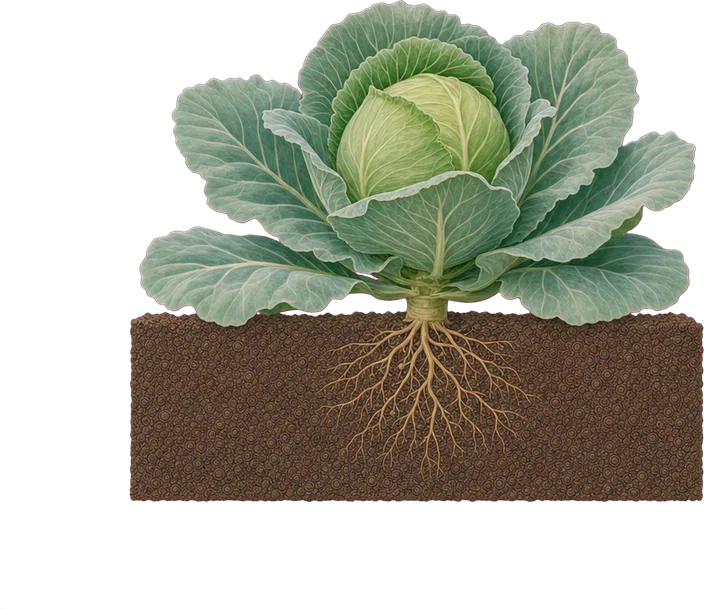
Cabbage starts indoors in late winter and goes out around the last frost. Cut the head when it's solid, before it splits.
Grown in Ohio, zone 6a. Your frost dates move the calendar; the signals don't. Broadfork goes by where your garden is, not its zone: frost dates for your ZIP code in the US, or the ones you type in anywhere else.
Seven minutes to read. Each section stands on its own.
- What you plant
- A transplant. Start the seed indoors 6 to 8 weeks before the frost-free date; the plants go out 4 to 6 weeks after they come up.
- When
- Around the last frost. Data with a last frost about April 22 sets the plants out from April 10 to 25.
- How deep
- Seed 1/4 to 1/2 inch deep. Transplants at the depth they grew in the pot.
- How far apart
- 12 inches apart in rows 24 inches apart, or 15 to 18 inches each way in a bed. The app plants cabbage 1 per square foot, 12 inches apart.
- Sun and soil
- Not in our rows yet.
- Frost
- Hardy. Hardened plants take a light frost, and mature plants take heavy frosts down to about 24 °F.
- Family
- Brassicaceae, the mustard family, with broccoli, cauliflower, kale, collards, kohlrabi and Brussels sprouts.
- Harvest
- When the head is solid and tight, before it splits. Most data gives 60 to 80 days from transplanting; early kinds can be ready in 45, long-season kinds take 100 or more.
- Soil pH
- 6.0 to 6.8, which also discourages clubroot. The data runs from 5.5 to 7.5.
- winterStart the seed indoors 6 to 8 weeks before the frost-free date.
- springSet the plants out around the last frost.
- summerCut the heads 60 to 80 days after setting out.
- fallKeep them for months in a root cellar at 32 to 40 °F.
Starting and planting#
Start the seed indoors 6 to 8 weeks before the frost-free date, 1/4 to 1/2 inch deep. The plants are ready to set out 4 to 6 weeks after they come up.
Don't hold them too long, or too cold. Young plants that sit for long below 50 to 55 °F are likely to bolt later, and 10 or more days at 35 to 50 °F can make cabbage flower early. Set out plants about 4 weeks old, and don't leave them below 50 °F for a week or more.
Harden them off gently. Cabbage is hardier than the warm-season crops and goes out sooner, but hardened too hard, it bolts.
Set them out around the last frost: data with a last frost about April 22 plants them from April 10 to 25. Hardened plants take a light frost.
Plant them at the depth they grew in the pot, water them in, and give each 1 cup of starter solution.
Space them 12 inches apart in rows 24 inches apart, or 15 to 18 inches each way in a bed.
Set out a summer planting on a cloudy, overcast or rainy day.
In Broadfork On a cabbage's crop page, and beside Companions on the add form, the app gives the seed depth and sets the plants at the depth they grew in the pot.
The season in between#
Net the plants the day they go in. Flea beetles come in early spring, cabbage maggot flies lay in early to mid-May, and the white butterflies whose young are cabbage worms are out from about mid-May. Seal the edges with soil, and leave the netting on until harvest; only a plant kept for seed flowers and needs it off.
In Broadfork When a cabbage goes in, the app puts bug netting on your list for that day, to stay on until harvest.
A row cover also keeps off cutworms, loopers and harlequin bugs.
Harvest#
Cut the heads while they're solid and tight, before they crack or split. Most data gives 60 to 80 days from transplanting; early kinds can be ready in 45, long-season kinds take 100 or more.
To hold a ready head a little longer, cut some of its roots with a spade, or twist the stalk to break a few. No data says how many days that buys.
In direct sun, heads sunblister and lose weight.
Cut close under the head and leave the loose outer leaves: small heads, 2 to 4 inches across, can grow from the stump. The data splits here: other data says cabbage won't form side shoots, and pulls the plants.
A medium head, about 5-3/4 inches across, weighs about 2 pounds.
Storing#
Cabbage can keep for months in a root cellar, ideally at 32 to 40 °F.
Saving seed#
Cabbage makes seed in its second year. Dig the plants or carry them over winter, store them at 32 to 45 °F, and replant them; the seed forms in dry pods.
It crosses with broccoli, kale, cauliflower, Brussels sprouts, kohlrabi and collards, all one species, so keep varieties a quarter mile apart, or half a mile in some data. That puts it among the hardest seed to save.
The seed is ripe when the plants dry out and turn orange-brown. Open a few of the oldest pods, which brown first. No data gives the days from flower to ripe seed.
Kept cold and sealed, the seed lasts about 4 years; some data says 3. The seed-saving guide shows how to store it.
Which cabbage#
Two kinds, by season: short-season cabbage, ready as soon as 45 days after transplanting, and long-season, at 100 days or more.
In the app's catalog, among others: Golden Acre, Early Jersey Wakefield, Copenhagen Market, Red Acre, Stone Head and Ruby Perfection.
What goes wrong#
- Cabbage worms: the young of the white butterflies, out from mid-May, with 3 to 5 generations a summer; some data says usually three. Netting from planting to harvest keeps them off.
- Cabbage maggots: the flies lay in early to mid-May. Have the netting up by then, or wait to plant until June 1. Keep cabbage off ground where onions or root crops grew last year.
- Flea beetles: early spring. Net the young plants while they grow.
- Harlequin bugs: stippled leaves, and plants that wilt as if scalded. Hand-pick and crush the eggs, young and adults, and clear the old plants at season's end, since the adults spend the winter in that debris.
- Plants that flower instead of heading: held too cold for too long while young, or hardened too hard.
- Split heads: the plant took up too much water near maturity. Cut ready heads before they split.
- Black rot: the bacteria live up to two years in old plants and often come in on the seed. Pull infected plants, clear the residue, clean your tools, and rotate.
- Clubroot: it strikes below pH 6.0 and lasts in the soil over 10 years, up to 18 in some data. Keep the soil pH at 6.0 to 6.8, and lime toward 7.2 once it shows. Never compost sick plants, and keep the cabbage family off that ground 4 to 7 years; some data says at least 6.
Where it goes next year#
Keep cabbage and the rest of its family out of a bed for 4 years.
Data plants a legume, such as beans or peas, after a heavy nitrogen feeder like cabbage.
In Broadfork The bed's rotation card counts the rest years for you and says which families are clear to go back in.
Every number on this page comes from a published extension source.
Sources for this guide: University of Minnesota Extension, University of Illinois Extension, Clemson Cooperative Extension, Ohio State University Extension, NC State Extension, Utah State University Extension, Iowa State University Extension and Outreach, New Mexico State, University of California, University of Kentucky Cooperative Extension, University of Maryland Extension, University of Missouri Extension, University of New Hampshire Extension, University of Wisconsin-Madison Division of Extension, Washington State University Extension, Colorado State University Extension, Oklahoma State University Extension, Oregon State University Extension, Penn State Extension, Purdue Extension, SDSU Extension, Texas A&M AgriLife Extension, UMass Extension, University of Georgia Extension, University of Nebraska–Lincoln Extension, WVU Extension.
The documents behind this guide (61)
- Growing asparagus in home gardens (2026), University of Minnesota Extension
- Growing broccoli in home gardens (2026), University of Minnesota Extension
- Growing cabbage in home gardens (2026), University of Minnesota Extension
- Growing eggplant in home gardens (2024), University of Minnesota Extension
- Planting the vegetable garden (2026), University of Minnesota Extension
- Saving vegetable seeds (2024), University of Minnesota Extension
- Starting seeds indoors (2026), University of Minnesota Extension
- UMN Cabbage and onion maggots (2022)
- UMN Caterpillars on cole crops (2022)
- UMN Flea beetles (2022)
- Illinois Extension, Home Vegetable Gardening crop pages (undated, no author shown)
- Illinois Extension, Home Vegetable Gardening crop pages (undated, no author shown)
- Illinois Extension, Home Vegetable Gardening: Turnip; Cabbage; Kohlrabi (undated). , /gardening/cabbage , /gardening/kohlrabi
- Starting a Garden: Hardening Off Indoor Seedlings (2020), University of Illinois Extension
- Time Your Vegetable Plantings by Cold Hardiness (2018), University of Illinois Extension
- When to Plant (2025), University of Illinois Extension
- Broccoli (2023), Clemson Cooperative Extension
- Cabbage & Chinese Cabbage (2023), Clemson Cooperative Extension
- Harvesting Vegetables (2020), Clemson Cooperative Extension
- Planting Depth (inches) (2021), Clemson Cooperative Extension
- Sweetpotato (2022), Clemson Cooperative Extension
- Growing Broccoli in the Home Garden (2017), Ohio State University Extension
- Growing Cabbage in the Home Garden (2018), Ohio State University Extension
- Growing Cauliflower in the Garden (2018), Ohio State University Extension
- Growing Peppers in the Home Garden (2017), Ohio State University Extension
- Ohio State BYGL: Harlequin Bug on Cleome (Young, 2017-07-26)
- Clubroot of Brassicas, NC State Extension
- NC State Extension, Pender County news: Tips for Harvesting Broccoli (Glen; 2021-12-02, updated 2022-08-19); corroboration class
- Vegetable Gardening, NC State Extension
- Black Rot, Utah State University Extension
- Collecting and Storing Seeds from Your Garden (2012), Utah State University Extension
- Row Covers (2020), Utah State University Extension
- Crop Rotation in the Vegetable Garden (2025), Iowa State University Extension and Outreach
- When should I harvest cabbage? (2024), Iowa State University Extension and Outreach
- for educational purposes (2019), New Mexico State
- Vegetable Seed Saving for Home Gardeners and Small-scale Farmers, Guide H-262 (Walker, Garvin, Tonnessen, Joukhadar), July 2022 (2022), New Mexico State
- Saving Seeds, University of California
- Seeds: Collecting & Storing (2025), University of California
- UK ENTfact 300: Cabbage Pests (Bessin, rev. 1/26)
- University of Kentucky ID-128: Home Vegetable Gardening in Kentucky, chapter 20, insect section (Durham ed., Bessin; revised 01-2024; read in full)
- Imported Cabbageworm on Vegetables (updated 2024-07-22)
- University of Maryland Extension: Harlequin Bug on Vegetables (updated 2025-08-19)
- Planning and planting guides (2017), University of Missouri Extension
- Starting Plants Indoors From Seeds (2022), University of Missouri Extension
- How do I save seeds for next year's garden? (2020), University of New Hampshire Extension
- Using Row Covers in the Garden (2020), University of New Hampshire Extension
- Degree Days for Common Fruit and Vegetable Insect Pests, University of Wisconsin-Madison Division of Extension
- Imported Cabbageworm (published 2026-01-30)
- A Step-by-Step Guide to Saving Seeds (seed-library binder) (2024), Washington State University Extension
- Broccoli, Cole crops: Clubroot (2025), Washington State University Extension
- Saving Seed, Fact Sheet 7.602 (2025), Colorado State University Extension
- Cole Crop Production (2017), Oklahoma State University Extension
- Collecting and storing seeds from your garden (Mansour, Hatch), May 2003, reviewed 2024 (2024), Oregon State University Extension
- Seed Saving Basics (2025), Penn State Extension
- Home Gardener's Guide (2026), Purdue Extension
- SDSU, Cabbage: How to Grow It (Burrows)
- Texas Home Vegetable Gardening Guide, Texas A&M AgriLife Extension
- Vegetable Bedding Plant Production and Pest Management, UMass Extension
- Fall Vegetable Gardening (2023), University of Georgia Extension
- Vegetable Garden Seed Storage and Germination Requirements, G2090 (2011), University of Nebraska–Lincoln Extension
- Growing Green Beans in West Virginia (2021), WVU Extension
Updated 11/11/2026 · Checked against our sources 11/12/2026