
Crop guide
Beans
Beans go in after the frost, once the soil has warmed, sown right where they'll grow. Pick them young and keep picking.
Grown in Ohio, zone 6a. Your frost dates move the calendar; the signals don't. Broadfork goes by where your garden is, not its zone: frost dates for your ZIP code in the US, or the ones you type in anywhere else.
Nine minutes to read. Each section stands on its own.
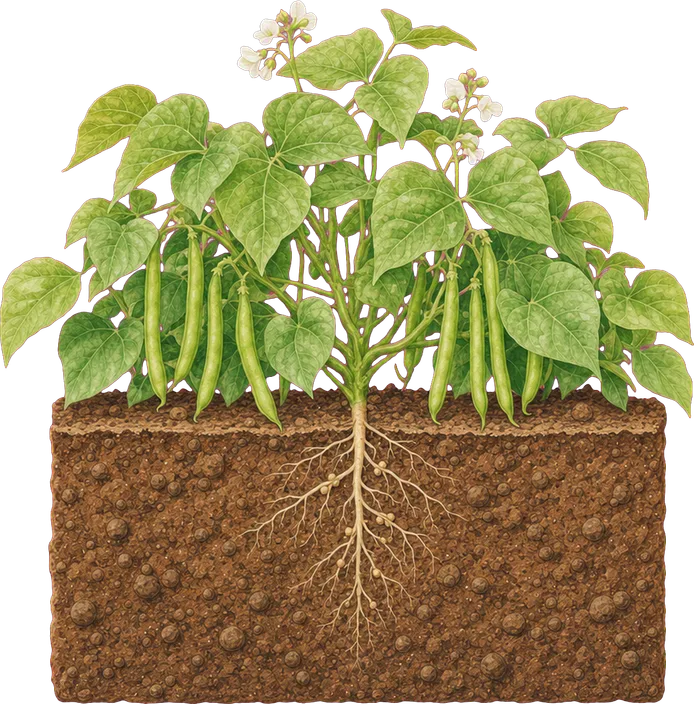
- What you plant
- Seed, sown where it will grow. Transplants aren't needed.
- When
- After the frost, once the soil is at least 60 °F, 4 inches down. The data runs from 55 to 69.
- How deep
- About 1 inch. The data runs from 1/4 inch to 2.
- How far apart
- Bush, 2 to 4 inches apart in rows 2 to 3 feet apart. Pole, 4 to 6 inches apart in rows 30 to 36 inches apart, or 4 to 6 seeds around each pole. The app plants bush beans 9 per square foot, 4 inches apart.
- Sun and soil
- At least 6 to 8 hours of sun; the data runs to 10. Well-drained soil of medium fertility, with compost at planting.
- Frost
- Tender. A light frost kills it, and growth slows above 80 °F or below 50 °F.
- Family
- Fabaceae, the legumes, with peas, peanuts and lentils.
- Harvest
- While the pods snap, before the seeds bulge. Bush beans take 50 to 60 days from sowing, pole beans 60 to 90; the data runs to 110.
- Soil pH
- About 6 to 7; the data goes as low as 5.8.
- springFirst sowing after the last frost, once the soil reaches 60 °F.
- summerFirst picking 50 to 60 days on, for bush beans.
- summerSow bush beans again every 2 to 3 weeks, until about August 1.
- fallThe first frost ends it.
Planting#
Wait for warm soil. Beans go in after the frost, once the soil is at least 60 °F, 4 inches down, since seed in cold, wet soil rots instead of sprouting. The data runs from 55 °F to 69, the high end to stay clear of root rot. If a frost threatens once they're up, cover them for the night.
Sow about 1 inch deep, deeper if the soil is very dry. Seedlings come up in 7 to 10 days at 65 to 85 °F.
Keep the soil moist, not soggy, until they're up. The data splits on soaking the seed first: one source says never, another says overnight in warm water.
On ground that hasn't grown beans for a few years, an inoculant made for beans, not the pea kind, may raise the yield.
Put pole supports up at planting, since setting them later can hurt the small plants: a trellis, fence or teepee 6 to 8 feet tall, sturdy enough for summer storms.
Bush beans finish quickly, so sow a short row every 2 to 3 weeks; the data runs from 10 days to 4 weeks. Stop about August 1, or by mid-July where fall comes early. Pole beans need only one or two plantings.
In Broadfork On a bush bean row, Plant again opens the add form for the same bean, dated two weeks on, our default interval.
Short season Where the season is short, the soil may not warm until late May or early June. Plastic mulch or a row cover lets beans go in 2 to 3 weeks before the last frost date. Grow the earliest bush beans, such as Contender and Provider.
Mild winter Where winters are mild, beans take two seasons: spring, and again from late July or August. The fall sowing runs to mid-September in the warmest places.
The season in between#
Give them about 1 inch of water a week, and don't let them go short from bloom until the pods have filled.
Water in the morning, at the soil, so the leaves dry before dark. Stay out of the row while the plants are wet: working among them spreads bacterial blight.
Go easy on nitrogen. Beans make their own once the roots are established, and too much delays the flowers and gives big plants with few beans. Work in compost at planting. With no soil test, one source gives about 3 pounds of 5-10-10 per 100 square feet. Most data adds nothing after that; two sources side-dress lightly, one before first bloom and one after pod set.
Once it's hot, lay 3 to 4 inches of weed-free straw or herbicide-free grass clippings to hold the water and stop the weeds. Weed shallow: the roots sit near the surface, and deep hoeing injures them.
Heat stops the flowers. They drop above about 85 °F; the data runs to 95, with dry soil. Keep the water even and wait: pods set again as the days cool.
In Broadfork Where a hot stretch is likely to reach a bean row, the app says so ahead of time, with the likely dates, and that picking may thin after it.
Harvest#
Pick while the pods snap and before the seeds bulge: about as thick as a pencil, 4 to 6 inches long, and 7 to 14 days after the flower.
Pick daily once they start; the data allows every 2 to 3 days. Mature pods left on the plant cut the yield, so take them all.
Wait until the dew is off, and mind the brittle stems. Bush plants bear for 2 to 3 weeks and pole plants for 5 to 6. Plan on 5 to 15 feet of row per person to eat fresh.
Storing#
Refrigerate them unwashed and loosely covered, and use them within 5 days; the data runs from 3 days to a week. They don't like it too cold: below 41 °F they discolor after 5 to 6 days, and rusty spots come at 41 to 45 °F.
To freeze them, blanch 3 minutes in boiling water, cool in ice water, drain and pack; one source blanches for just 1 minute. Green beans are a low-acid food: can them only in a pressure canner, never a boiling-water bath.
For dry beans, leave the pods on until they're dry and brown and the seeds rattle. If a cold, rainy fall comes early, pull the whole plant and hang it indoors. Shell them and dry them further, since any moisture left will mold, then kill any weevils: 0 °F or below for at least 48 hours, or 30 minutes in a 160 °F oven.
Beans kept for seed get at least 2 weeks indoors before shelling. Save your own seed has the rest.
Which beans#
Bush beans grow 2 to 3 feet tall, need no staking and suit small spaces. Pole beans climb 5 to 6 feet and more, and give higher yields over a longer stretch in less space. Half-runners fall between, at 3 to 4 feet.
Snap beans are grown for the pod, shelling and dry beans for the seed, and some varieties do all three. Pods come green, yellow (called wax), purple or striped, round or flat.
Derby and Provider resist bean common mosaic virus, and Wade and Black Valentine resist or tolerate Mexican bean beetle. Blue Lake 274 drops its blossoms readily above 90 °F.
In the app's catalog, among others: Blue Lake 274, Provider, Contender, Dragon Tongue, Kentucky Wonder and Rattlesnake.
What goes wrong#
- Seed doesn't come up, or seedlings stunt: cold, wet soil rots it, root rot takes it on low, poorly drained ground, and seedcorn maggots eat it in cool weather. Sow in warm soil, in a raised bed if the ground stays wet.
- All leaves and few pods, or flowers dropping: too much nitrogen, heat, or soil too dry or too wet for too long.
- Mexican bean beetle: orange to copper with 16 spots, and yellow larvae with black spines, eating the leaves from beneath, most in July and August. Crush them. A row cover can stay on from planting to harvest, since beans don't need insect pollinators, though some data takes it off by mid-June if heat builds.
- Bean leaf beetle: round 1/8-inch holes in young leaves. It can kill seedlings, so cover the row.
- Mosaic virus: mottled, yellowish leaves and few or no pods. Aphids and seed spread it and nothing cures it, so grow a resistant variety.
- Blights and anthracnose: brown or black spots on leaves and pods, worst in wet weather. They ride on seed and last two years in debris. Start with clean seed, and keep the leaves dry.
- Rust: rust-colored spots under the leaves. It winters in debris and on last year's poles.
- White mold: soft, watery pods and white cottony growth with hard black specks, in cool, damp weather. Give the plants air, and never compost them. The specks can last in the soil; the data runs to ten years.
- Rabbits eat whole rows. A 2-foot chicken wire fence with its bottom buried stops them.
Where it goes next year#
Beans share a family with peas, so keep both out of a bed for 3 to 4 years, 5 or more if you can.
Don't count on beans to feed the next crop. They rarely fix much more than 40 pounds of nitrogen an acre in a season, and they stop at flowering and move much of it into the seed. What's left depends on the plants: pull them and you get the least, turn them under and you get more.
After the last picking, take out any diseased or beetle-ridden plants: beetles winter under plant debris. Healthy plants can be worked in or composted, though some data takes everything out. Garlic can follow an early crop of beans; otherwise, once the bed is empty, cover the soil.
In Broadfork The bed's rotation card counts the rest years for you and says which families are clear to go back in.
Every number on this page comes from a published extension source.
Sources for this guide: University of Minnesota Extension, Clemson Cooperative Extension, Iowa State University Extension and Outreach, University of Illinois Extension, Penn State Extension, Utah State University Extension, University of Maryland Extension, Colorado State University Extension, Texas A&M AgriLife Extension, Virginia Cooperative Extension, Ohio State University Extension, SDSU Extension, UMass Extension, University of Florida, University of Missouri Extension, University of Nebraska–Lincoln Extension, Alabama Cooperative Extension System, National Center for Home Food Preservation, NC State Extension, Oregon State University Extension, Purdue Extension, SARE, University of Alaska Fairbanks, University of California, University of Delaware Cooperative Extension, University of Georgia Extension, University of Wisconsin-Madison Division of Extension, WVU Extension.
The documents behind this guide (80)
- Bean leaf beetles (2026), University of Minnesota Extension
- Deformed pod, University of Minnesota Extension
- Discolored leaves, University of Minnesota Extension
- Growing beans in home gardens (2024), University of Minnesota Extension
- Growing cucumbers in home gardens (2026), University of Minnesota Extension
- Growing melons in the home garden (2026), University of Minnesota Extension
- Growing pumpkins and winter squash in home gardens (2026), University of Minnesota Extension
- Growing summer squash and zucchini in home gardens (2024), University of Minnesota Extension
- Growing sweet corn in home gardens (2026), University of Minnesota Extension
- How excessive heat affects the vegetable garden (2025), University of Minnesota Extension
- Leaves wilt, University of Minnesota Extension
- Poor or no emergence, University of Minnesota Extension
- Saving vegetable seeds (2024), University of Minnesota Extension
- Spots on leaves, University of Minnesota Extension
- Bean & Southern Pea Diseases (2025), Clemson Cooperative Extension
- Bean & Southern Pea Insect Pests (2025), Clemson Cooperative Extension
- Bush & Pole-Type Snap Beans (2023), Clemson Cooperative Extension
- How to Grow Okra in South Carolina (2025), Clemson Cooperative Extension
- Planting Depth (inches) (2021), Clemson Cooperative Extension
- Southern Peas (2023), Clemson Cooperative Extension
- Sweetpotato (2022), Clemson Cooperative Extension
- All About Beans (2024), Iowa State University Extension and Outreach
- Common Problems of Green Beans in the Home Garden (2026), Iowa State University Extension and Outreach
- Crop Rotation in the Vegetable Garden (2025), Iowa State University Extension and Outreach
- Growing Green Beans (2023), Iowa State University Extension and Outreach
- How late can I plant snap beans? (2024), Iowa State University Extension and Outreach
- When can I plant snap beans in the garden? (2024), Iowa State University Extension and Outreach
- Corn, University of Illinois Extension
- How to Save Seeds (2021), University of Illinois Extension
- Illinois Extension, Home Vegetable Gardening crop pages (undated, no author shown)
- Put your garden to bed with fall/winter cover crops! (2021), University of Illinois Extension
- Snap Beans, University of Illinois Extension
- When to Plant (2025), University of Illinois Extension
- Dried Beans Versus Fresh Shelled Beans (2025), Penn State Extension
- Growing beans should be a snap for most gardeners (2009), Penn State Extension
- How to Preserve Green and Yellow Beans (2026), Penn State Extension
- Inoculation of Forage and Grain Legumes (2025), Penn State Extension
- Snap Bean Production (2005), Penn State Extension
- Bean and Cowpea Weevils, Utah State University Extension
- Harvest and Storage of Vegetables and Fruits (2015), Utah State University Extension
- How to Grow Beans in Your Garden (2020), Utah State University Extension
- Mexican Bean Beetle, Utah State University Extension
- Row Covers (2020), Utah State University Extension
- Growing Beans in a Home Garden (2026), University of Maryland Extension
- Mexican Bean Beetle - Vegetables (2023), University of Maryland Extension
- Poor Blossom and Fruit Set of Vegetables (2023), University of Maryland Extension
- Rabbits (2023), University of Maryland Extension
- Cover Crops and Green Manure Crops (2023), Colorado State University Extension
- Vegetable Gardening: Nitrogen Recommendations (2025), Colorado State University Extension
- White Mold of Dry Beans (2025), Colorado State University Extension
- Bean (Snap, Lima, and Butter Beans), Texas A&M AgriLife Extension
- Easy Gardening: Mulching (2014), Texas A&M AgriLife Extension
- Texas Home Vegetable Gardening Guide, Texas A&M AgriLife Extension
- Beans (2025), Virginia Cooperative Extension
- Mulching: Purpose, Benefits, and Essential Information (2025), Virginia Cooperative Extension
- Seed For The Garden, 426-316 (SPES-392P) (2022), Virginia Cooperative Extension
- Defoliators on Soybean (2014), Ohio State University Extension
- Selecting, Storing, and Serving Ohio Beans (2021), Ohio State University Extension
- Green Beans: How to Grow It (2024), SDSU Extension
- Nitrogen Credit: The Rest of the Story (2020), SDSU Extension
- Bean, Anthracnose (2013), UMass Extension
- Mexican Bean Beetle (2013), UMass Extension
- Bush Beans, University of Florida
- Pole Beans, University of Florida
- Nitrogen Replacement Value of Legumes (2022), University of Missouri Extension
- Planning and planting guides (2017), University of Missouri Extension
- Overall Efficiency of Fertilizer Nitrogen Use for Corn (2019), University of Nebraska–Lincoln Extension
- Vegetable Garden Seed Storage and Germination Requirements, G2090 (2011), University of Nebraska–Lincoln Extension
- Vegetable Seasons in Alabama (2025), Alabama Cooperative Extension System
- Freezing Beans: Green, Snap, or Wax (2014), National Center for Home Food Preservation
- Vegetable Gardening: A Beginner's Guide (2023), NC State Extension
- Getting the most from your backyard bean crop (2026), Oregon State University Extension
- Home Gardener's Guide (2026), Purdue Extension
- Managing Cover Crops Profitably, SARE
- Recommended Variety List for Interior Alaska (2022), University of Alaska Fairbanks
- Saving Seeds, University of California
- Non-Chemical Pest Control: Beans (2025), University of Delaware Cooperative Extension
- Home Garden Green Beans (2026), University of Georgia Extension
- White Mold (2024), University of Wisconsin-Madison Division of Extension
- Growing Green Beans in West Virginia (2021), WVU Extension
Updated 11/11/2026 · Checked against our sources 11/12/2026