Crop guide
Peas
Peas go in early, while the soil is still cold and frost is still likely. The summer heat ends them.
Grown in Ohio, zone 6a. Your frost dates move the calendar; the signals don't. Broadfork goes by where your garden is, not its zone: frost dates for your ZIP code in the US, or the ones you type in anywhere else.
Six minutes to read. Each section stands on its own.
- What you plant
- Seed, sown where it will grow.
- When
- Early spring, among the first crops in, once the soil is at least 45 °F.
- How deep
- About 1 inch. The data runs from 1 to 3.
- How far apart
- 2 inches apart in rows 24 inches apart, or 2 to 4 inches each way in a wide bed. The app plants peas 8 per square foot, 4 inches apart.
- Sun and soil
- Not in our rows yet.
- Frost
- Very hardy. It takes hard frosts.
- Family
- Fabaceae, the pea family, with beans and edamame.
- Harvest
- Snow peas at full pod length, snap peas when the pods look almost filled, shelling peas at full size. Check them every day.
- Soil pH
- About 6 to 7.5, with 6.5 a common target; the data goes as low as 5.8.
- springSow once the soil reaches 45 °F, before the last frost.
- summerPicking stops once the days pass 85 °F.
- fallA fall crop takes 70 to 80 days, longer than in spring.
Planting#
Peas are among the first crops in. They take hard frosts and grow at anything above 40 °F. Sow once the soil is at least 45 °F. Data with a last frost about April 22 sows them from March 25 to April 10.
Sow about 1 inch deep in a narrow trench, and firm the soil over the seed. The data runs from 1 inch to 3.
Set them 2 inches apart in rows 24 inches apart, or 2 to 4 inches each way in a wide bed.
Seed for an early sowing in cold soil can be bought treated with a fungicide. The packet says whether it is.
If no peas have grown in that ground for three years, coat the seed with a pea inoculant first, as a powder on moistened seed or as granules in the row. Buy the kind made for peas, keep it cold but never frozen, and plant within 24 hours. In an established garden it matters less.
In Broadfork On a pea's crop page, and beside Companions on the add form, the app gives the sowing depth and the inoculant reminder.
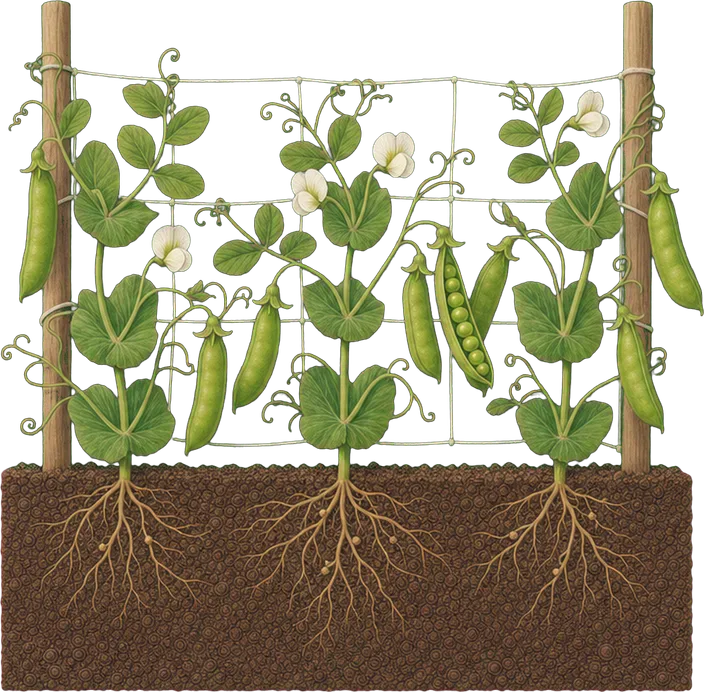
Put up netting or brush for them to climb before or right after you sow. Set it on the north side of the garden, so the vines don't shade the shorter crops.
A fall crop takes longer: data lists fall peas at 70 to 80 days, longer than in spring.
The season in between#
Peas grow best between 55 and 65 °F. Above 85 °F they stop growing and make no more flowers or pods, so the heat, not the calendar, ends the crop.
In Broadfork On the Timeline, a pea planting's harvest bar ends where your garden's normal highs pass 85 °F, and ticking Plan for shade cloth moves that end later.
Don't feed them nitrogen: data says it can cut the yield of peas and beans. Use an inoculant instead, and don't side-dress.
Harvest#
Pick by the kind. Snow peas are ready at full pod length, while the peas inside barely show. Snap peas are ready when the pods look almost filled, and shelling peas once the peas are full size.
Taste them every day once they start. Past their best they turn starchy, less sweet and tough-skinned, and within one to three days they're no good fresh.
The shoots are a second crop: the growing tip with its top leaves, tendrils and any flowers, 2 to 6 inches long. Cut the first at 8 to 12 inches tall, before the pods, then again every 3 to 4 weeks. A planting cut for shoots can still bear pods.
Saving seed#
Leave the pods on the vine until they're brown and dry and the seeds rattle inside. That can take as long as a month past the eating harvest. Then dry them indoors before shelling: 1 to 2 weeks in some data, at least two in other.
Peas pollinate themselves, so a few plants give good seed. Keep 50 feet between varieties, and don't save from diseased plants. Kept cold and sealed, the seed lasts about 3 years; the seed-saving guide shows how to store it.
Which peas#
There are three kinds. Snow peas and snap peas are eaten pod and all; shelling peas are grown for the peas inside.
In the app's catalog, among others: Sugar Snap, Sugar Ann, Oregon Sugar Pod II, Green Arrow, Little Marvel, Wando and Tall Telephone.
What goes wrong#
- The vines quit as the summer heats up: above 85 °F they stop flowering. Sow as early as the soil allows.
- Seed that never comes up in cool, wet soil: seedcorn maggots eat it. Keep fresh manure off the bed, turn a cover crop under 3 to 4 weeks before sowing, and sow a few extra seeds. If the seedlings are lost, sow again 5 to 10 days later.
- Seedlings that rot at the soil line, or roots that die and leaves that yellow: root rots and damping off, worst on low, poorly drained ground. Use a raised bed, and rotate peas with other vegetables.
- Ascochyta blight: it lives over winter in old vines or comes in on the seed. Pull infected plants when you see them and the rest after harvest, and start with clean seed. For bacterial blight, clear out all the old vines in fall.
- Rabbits eat whole rows. A 2-foot chicken wire fence with its bottom buried stops them.
- Seeds that don't come up, or twisted, cupped seedlings: weed killer carried in hay, manure or compost. Peas are sensitive to it, and the pot test for it grows pea or bean seeds in the suspect compost.
Where it goes next year#
Peas share a family with beans. Keep both out of a bed for 3 to 4 years, 5 or more if you can, since blight lives on in the old vines.
Don't count on peas to feed the next crop. A legume stops fixing nitrogen at flowering and moves much of it into the seed you pick.
Garlic can follow peas picked earlier in the season.
In Broadfork The bed's rotation card counts the rest years for you and says which families are clear to go back in.
Every number on this page comes from a published extension source.
Sources for this guide: University of Minnesota Extension, Clemson Cooperative Extension, University of Illinois Extension, Colorado State University Extension, Purdue Extension, NC State Extension, Ohio State University Extension, Penn State Extension, SDSU Extension, Texas A&M AgriLife Extension, University of California, University of Florida, University of Kentucky Cooperative Extension, University of Maryland Extension, University of Nebraska–Lincoln Extension, Utah State University Extension, Virginia Cooperative Extension, Washington State University Extension, Iowa State University Extension and Outreach, Montana State, New Mexico State, Oregon State University Extension, SARE, UMass Extension, University of Connecticut, University of Delaware Cooperative Extension, University of Missouri Extension, University of New Hampshire Extension, University of Wisconsin-Madison Division of Extension, WVU Extension.
The documents behind this guide (74)
- Growing beans in home gardens (2024), University of Minnesota Extension
- Growing cucumbers in home gardens (2026), University of Minnesota Extension
- Growing eggplant in home gardens (2024), University of Minnesota Extension
- Growing melons in the home garden (2026), University of Minnesota Extension
- Growing peas in home gardens (2024), University of Minnesota Extension
- Growing pumpkins and winter squash in home gardens (2026), University of Minnesota Extension
- Growing strawberries in the home garden (2024), University of Minnesota Extension
- Growing summer squash and zucchini in home gardens (2024), University of Minnesota Extension
- Growing sweet corn in home gardens (2026), University of Minnesota Extension
- Planting the vegetable garden (2026), University of Minnesota Extension
- Planting vegetables in midsummer for fall harvest (2026), University of Minnesota Extension
- Poor or no emergence, University of Minnesota Extension
- Saving vegetable seeds (2024), University of Minnesota Extension
- UMN Extension: Cabbage and onion maggots (Schuh, Hahn, Wold-Burkness; reviewed 2022)
- UMN Extension: Seedcorn maggot, soybean pest management (base 39 F, peaks 354, 1,080, 1,800 DD; search summary)
- Bean & Southern Pea Diseases (2025), Clemson Cooperative Extension
- Broccoli (2023), Clemson Cooperative Extension
- Bush & Pole-Type Snap Beans (2023), Clemson Cooperative Extension
- Garden Peas (2023), Clemson Cooperative Extension
- Growing Strawberries in South Carolina (2025), Clemson Cooperative Extension
- How to Grow Okra in South Carolina (2025), Clemson Cooperative Extension
- Planting Depth (inches) (2021), Clemson Cooperative Extension
- Southern Peas (2023), Clemson Cooperative Extension
- Sweetpotato (2022), Clemson Cooperative Extension
- Corn, University of Illinois Extension
- How to Save Seeds (2021), University of Illinois Extension
- Illinois Extension, Home Vegetable Gardening crop pages (undated, no author shown)
- Snap Beans, University of Illinois Extension
- Time Your Vegetable Plantings by Cold Hardiness (2018), University of Illinois Extension
- When to Plant (2025), University of Illinois Extension
- Saving Seed, Fact Sheet 7.602 (Ells, Whiting, Shonle), 1996, reviewed Aug 2025 (2025), Colorado State University Extension
- Vegetable Gardening: Nitrogen Recommendations (2025), Colorado State University Extension
- White Mold of Dry Beans (2025), Colorado State University Extension
- Home Gardener's Guide (2026), Purdue Extension
- Purdue Extension E-21-W: Managing Insects in the Home Vegetable Garden (Foster and Obermeyer, October 2017 printing; read in full)
- Purdue Extension E-30: Cucurbit Insect Management (Foster, March 2016)
- Herbicide Carryover in Hay, Manure, Compost, and Grass Clippings (2024), NC State Extension
- Vegetable Gardening: A Beginner's Guide (2023), NC State Extension
- Growing Garlic in the Garden, Ohio State University Extension
- Growing Rhubarb in the Home Garden (2021), Ohio State University Extension
- Inoculation of Forage and Grain Legumes (2025), Penn State Extension
- Seed Saving Basics (Miklas, Neves), updated 2026-09-24; Master Gardener authors, corroboration (2026), Penn State Extension
- Green Beans: How to Grow It (2024), SDSU Extension
- Nitrogen Credit: The Rest of the Story (2020), SDSU Extension
- Bean (Snap, Lima, and Butter Beans), Texas A&M AgriLife Extension
- Texas Home Vegetable Gardening Guide, Texas A&M AgriLife Extension
- Saving Seeds, University of California
- Seeds: Collecting & Storing (2025), University of California
- Bush Beans, University of Florida
- Pole Beans, University of Florida
- UK ENTfact 309: Seedcorn Maggots (Bessin, rev. 1/26)
- University of Kentucky ID-128: Home Vegetable Gardening in Kentucky, chapter 20, insect section (Durham ed., Bessin; revised 01-2024; read in full)
- Growing Beans in a Home Garden (2026), University of Maryland Extension
- Rabbits (2023), University of Maryland Extension
- Overall Efficiency of Fertilizer Nitrogen Use for Corn (2019), University of Nebraska–Lincoln Extension
- Vegetable Garden Seed Storage and Germination Requirements, G2090 (2011), University of Nebraska–Lincoln Extension
- Collecting and Storing Seeds from Your Garden (Beddes, Drost, McClain), Nov 2012 (2012), Utah State University Extension
- How to Grow Beans in Your Garden (2020), Utah State University Extension
- Beans (2025), Virginia Cooperative Extension
- Seed For The Garden, 426-316 (SPES-392P) (2022), Virginia Cooperative Extension
- WSU Extension, PNW 567: Pea shoots (Miles, O'Dea, Daniels, King; 2018); record read, text not
- WSU King County Cooperative Extension, Food from the Field: Pea Shoots (Alleman; 1999); consumer brochure
- Crop Rotation in the Vegetable Garden (2025), Iowa State University Extension and Outreach
- Diseases of Cool Season Legumes, Montana State
- Vegetable Seed Saving for Home Gardeners and Small-scale Farmers, Guide H-262 (Walker, Garvin, Tonnessen, Joukhadar), July 2022 (2022), New Mexico State
- Collecting and storing seeds from your garden (Mansour, Hatch), May 2003, reviewed 2024 (2024), Oregon State University Extension
- Managing Cover Crops Profitably, SARE
- Bean, Anthracnose (2013), UMass Extension
- Peas (2017), University of Connecticut
- University of Delaware, Weekly Crop Update: Pea Shoots (Ernest, crediting Johnson; 2023-03-03); a specialist's news post
- Planning and planting guides (2017), University of Missouri Extension
- How do I save seeds for next year's garden? (2020), University of New Hampshire Extension
- Degree Days for Common Fruit and Vegetable Insect Pests, University of Wisconsin-Madison Division of Extension
- Growing Green Beans in West Virginia (2021), WVU Extension
Updated 11/11/2026 · Checked against our sources 11/12/2026