
How to
Save your own seed
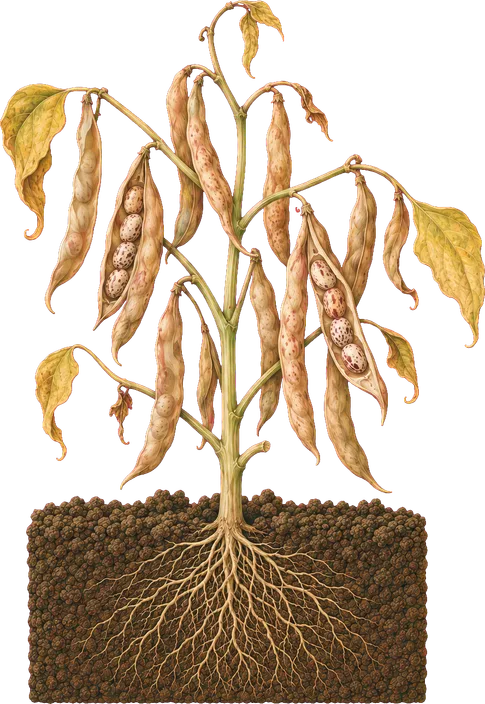
The bean pods have dried brown on the plant. Pick them, let them dry a little longer indoors, and next year's seed is in your hand.
Grown in Ohio, zone 6a. Your frost dates move the calendar; the signals don't. Broadfork goes by where your garden is, not its zone: frost dates for your ZIP code in the US, or the ones you type in anywhere else.
Four minutes to read. The steps stand on their own.
Before you start#
Save seed only from open-pollinated varieties. Hybrids don't come true from seed: their plants come up weaker and mixed, usually with smaller flowers and a smaller crop.
Start with beans, peas, lettuce and tomatoes. They pollinate themselves, so a few plants give good seed. Crops that cross with their neighbors, and the ones that take two years to make seed, are harder; they're at the end.
Keep other varieties of the same crop at a distance: 100 feet for beans, 50 for peas and lettuce, 25 to 100 for tomatoes. Potato-leaf tomatoes want the far end of that.
Don't save seed from a diseased plant.
The steps#
- Let beans and peas dry on the plant. Leave the pods until they're dry and brown. On peas, the seeds rattle inside.
- Finish drying them indoors, then shell them. At least 2 weeks for beans and 1 to 2 for peas. They're dry enough when you could snap a seed by hand.
- Cut lettuce seed stalks when they turn fluffy. Take them just before all the seed is dry, so the light seed isn't lost.
- Scoop tomato seed out of fully ripe fruit into a little water. The gel around each seed has to come off.
- Let it ferment 2 to 4 days, stirring every day. The good seed sinks; the pulp and the bad seed float. The data runs from 2 to 3 days up to five, and the soak also kills disease carried on the seed.
- Store it cool, dry and sealed. Sealed glass with a desiccant at 32 to 41 °F, or anywhere 35 to 45 °F with low humidity. At the simple end, an envelope in a cool, dry place the mice can't reach.
In Broadfork Mark a planting Saving seed, and Broadfork stops telling you to pull it; where the data gives a crop's time to dry on the plant, its end date moves out by that much.
How long it keeps#
Onion seed is the shortest-lived: about a year, 2 by another table. Sweet corn keeps about 2 years, and peppers 2 by one table and 4 by another.
Beans and peas keep about 3 years, carrots 2 to 3. Tomatoes keep 3 by one table, 4 by another and 5 to 10 by a third.
Squash keeps about 4, 5 by another table. Cucumbers and lettuce keep about 5, though the data puts cucumbers as high as 10 and lettuce as low as 2 to 3.
Frozen in an airtight container, seed can last up to 10 years. Every one of these figures is an average, not a promise: how the plant grew and how the seed was stored decide it.
If it goes wrong#
- Nothing like the parent
- It was a hybrid. Save from open-pollinated varieties only.
- Off-type plants from good seed
- It crossed with a neighbor. More distance next time, or stay with the crops that pollinate themselves.
- Little of it sprouts
- Old seed, or seed kept warm or damp. Use it while it's young, and store it cool, dry and sealed.
- Sickly seedlings
- The disease came on the seed. Save only from healthy plants, and ferment tomato seed.
The harder ones, by crop#
- Peppers: seed from fully ripened fruit, 500 feet from other varieties, and hot peppers well away from sweet. Some varieties cross more readily than others.
- Cucumbers and squash: leave the fruit on far past eating. Cucumbers stay several weeks, until they turn yellow or orange; summer squash stays until the rind hardens. They cross with other varieties of their kind from 1500 feet to a mile away. Cucumbers cross only with cucumbers, and among squash only the same species cross.
- Corn: the wind carries its pollen, and the data asks a half mile to 2 miles from other corn. It needs at least 100 plants, better 200, or the line weakens. Popcorn can cross into sweet corn from a nearby garden on a windy day.
- Carrots, beets, onions and the cabbage family make seed in their second year. Dig the roots in fall, store them at 32 to 45 °F through the winter, and replant them in spring. Carrots cross with Queen Anne's lace, beets with chard, and cabbage, broccoli, kale and their kin all with each other.
Every number on this page comes from a published extension source.
Sources for this guide: SDSU Extension, University of California, University of Nebraska–Lincoln Extension, Colorado State University Extension, NC State Extension, New Mexico State, Penn State Extension, University of Georgia Extension, University of Illinois Extension, University of Maine Cooperative Extension, University of Minnesota Extension, University of New Hampshire Extension, Utah State University Extension, Virginia Cooperative Extension, Washington State University Extension.
The documents behind this guide (18)
- Saving Seed of Pumpkins, Squash, Cucumbers, Melons and Gourds (2019), SDSU Extension
- Saving Seed: Will the seed produce plants similar…? (2024), SDSU Extension
- Saving Seeds, University of California
- Seeds: Collecting & Storing (2025), University of California
- Vegetable Garden Seed Storage and Germination Requirements, G2090 (2011), University of Nebraska–Lincoln Extension
- Weird Squash: Pollination Gone Wrong? (2022), University of Nebraska–Lincoln Extension
- Saving Seed, Fact Sheet 7.602 (2025), Colorado State University Extension
- Saving Squash Seeds (2023), NC State Extension
- Vegetable Seed Saving for Home Gardeners and Small-scale Farmers, H-262 (2022), New Mexico State
- Seed Saving Basics (2025), Penn State Extension
- Pollination of Vegetable Crops, C 934 (2022), University of Georgia Extension
- How to Save Seeds (2021), University of Illinois Extension
- Bulletin #2750, An Introduction to Seed Saving for the Home Gardener (2010), University of Maine Cooperative Extension
- Saving vegetable seeds (2024), University of Minnesota Extension
- How do I save seeds for next year's garden? (2020), University of New Hampshire Extension
- Collecting and Storing Seeds from Your Garden (2012), Utah State University Extension
- Seed For The Garden, 426-316 (SPES-392P) (2022), Virginia Cooperative Extension
- A Step-by-Step Guide to Saving Seeds (seed-library binder) (2024), Washington State University Extension
Updated 11/11/2026 · Checked against our sources 11/12/2026