
Crop guide
Summer squash
Summer squash goes in once the frost is past and the soil is warm, sown right where it'll grow. Pick it young, every day or two.
Grown in Ohio, zone 6a. Your frost dates move the calendar; the signals don't. Broadfork goes by where your garden is, not its zone: frost dates for your ZIP code in the US, or the ones you type in anywhere else.
Nine minutes to read. Each section stands on its own.
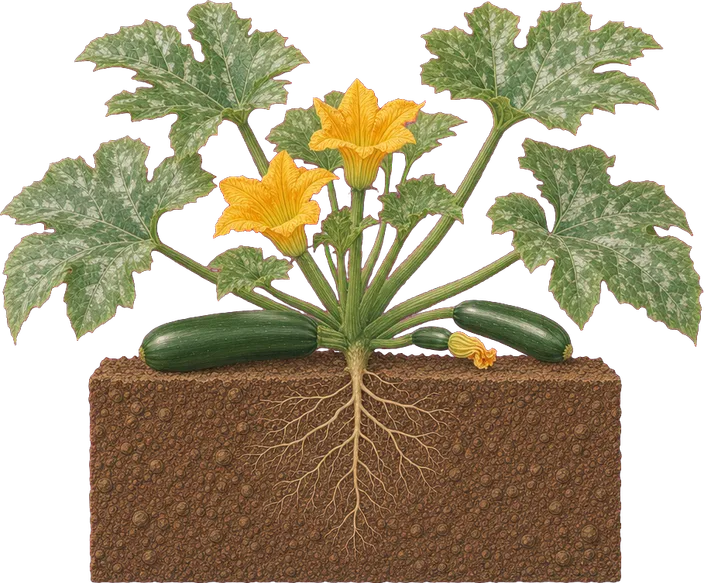
- What you plant
- Seed, sown where it will grow. Plants started indoors and set into cold soil grow poorly.
- When
- After the last frost, once the soil is at least 60 °F; some data waits for 70 °F, 2 inches down.
- How deep
- 1/2 to 1 inch. The data runs to 2.
- How far apart
- Thinned to 12 to 15 inches in rows about 3 feet apart, or 2 or 3 plants to a hill 3 to 4 feet apart; the data runs from 8 inches to 3 feet. The app spaces them 18 inches apart.
- Sun and soil
- Full sun, at least 6 hours; 8 to 10 is better. Fertile, well-drained soil with compost.
- Frost
- Tender. It grows best at 65 to 75 °F.
- Family
- Cucurbitaceae, with cucumbers and melons; the same species as acorn squash and jack-o'-lantern pumpkins.
- Harvest
- Young, while the skin is tender: long kinds at 6 to 8 inches, pattypan at 3 to 4 inches across, from about 50 to 65 days; the data runs from 35 to 75.
- Soil pH
- About 6.0 to 6.5; the data runs from 5.8 to 7.5.
- springFirst sowing after the last frost, with the soil at 60 to 70 °F.
- summerBorer moths fly, often as the first flowers open.
- summerFirst picking 50 to 65 days on, then every day or two.
- summerSow again in early July, after the moths finish laying.
- fallThe first frost ends it.
Planting#
Wait for warm soil, since seed won't sprout in cold soil. Sow after the last frost, once the soil reaches 60 to 70 °F, the high end measured 2 inches down.
Sow 1/2 to 1 inch deep, 4 to 6 inches apart in a row or 4 to 6 seeds to a hill. At the first true leaves, cut the extras off with scissors, leaving one plant every 12 to 15 inches, or 2 or 3 to a hill.
For an early crop, start seed indoors 3 to 4 weeks ahead in 3-inch pots you'll plant whole, and harden them off, never below 55 °F.
Black plastic warms the soil for an earlier start; hold straw mulch until the soil reaches 75 °F. A row cover from seeding keeps off cold nights and insects; take it off when flowering begins, for the bees.
For a longer harvest, sow part of the bed about three weeks after the rest, or plant again in early July, after the borer has finished laying.
Short season Where the season is short, the soil may not reach 70 °F until late May or early June. Under plastic mulch and a row cover, plants can go out 2 to 3 weeks before the last frost.
Mild winter Where winters are mild, there are two seasons: spring, from as early as March, and fall, sown from mid-July into September. Plant the spring crop early, before the borers and pickleworms build.
The season in between#
Give it about 1 inch of water a week; the data runs to 2. Water at the base in the morning, so the leaves dry by dark, and keep it steady once fruit forms.
Before planting, work in about 3 pounds of 5-10-10 per 100 square feet, or compost. Side-dress as the vines start to run or the female flowers appear; the data runs to a week after bloom. Too much nitrogen makes vine instead of fruit.
Hoe the weeds while they're young, then mulch the shallow roots. Straw around the stems discourages the borer, but squash bugs hide in it.
The first flowers are male and drop off; that's normal. Females follow a few days to 2 weeks later, each with a tiny squash at its base, and bees carry the pollen. When bees are scarce, move the pollen yourself with a cotton swab, male to female. Heat kills the pollen and turns the plant to mostly male flowers.
In Broadfork Where a hot stretch is likely to reach a squash planting, the app says so ahead of time, with the likely dates, and that picking may thin after it.
Harvest#
Pick by size: long kinds at 6 to 8 inches long and 1 1/2 to 2 inches across, yellow crookneck at 4 to 7 inches, pattypan at 3 to 4 inches across. That's 3 to 8 days after the flower opens. If your thumbnail can't mark the rind, it's past its best.
Pick every day or two, leaving an inch or two of stem, and not while the vines are wet. Take off any that got too big, used or not: left on, they slow the plant.
Plan on 20 to 40 pounds from 10 feet of row; four to six plants feed a family of four.
Storing#
Refrigerate it unwashed in a bag and use it within about four days; the data runs from 2 days to a week. Held cold longer, the skin pits. In a cool, damp place at 32 to 50 °F it keeps 5 to 14 days; some data says 2 to 4 days at 45 to 55 °F.
To freeze it, blanch 1/2-inch slices 3 minutes, cool, drain and pack with 1/2 inch of headspace. Grated zucchini gets 1 to 2 minutes over steam. One source says it doesn't freeze well.
No tested home canning process covers summer squash on its own. One source says don't can it, since it turns mushy; another says use a pressure canner. Or dry 1/4-inch slices at 115 °F for 6 to 12 hours, until crisp.
Which summer squash#
Three shapes: yellow crookneck and straightneck, flat round pattypan, and zucchini, long or round. Most grow as bush plants that fit a small garden.
Zucchini takes the worst of the squash vine borer. Yellow crookneck takes less, bush plants more than vining ones, and tromboncino resists it.
Summer squash crosses with pumpkins and acorn squash, but the cross shows only in saved seed, never in this year's fruit. Save your own seed has the rest.
In the app's catalog, among others: Black Beauty, Spineless Beauty, Eight Ball, Yellow Crookneck, Early Prolific Straightneck and Sunburst.
Short season Where the season is short, summer squash suits it better than most cucurbits, at 50 to 65 days. The data names early ones such as Early Prolific, Gold Rush and Raven.
What goes wrong#
A squash that tastes very bitter can make you sick. Don't eat it: that bitterness comes from one gene, not the weather, and 3 grams has caused cramps and diarrhea lasting days. Throw it out, never give it away, and don't save its seed. Expect that plant's other fruit to be bitter too.
The squash vine borer hits zucchini hardest. Its moths come out between mid-May and early July, often as the first flowers open, with one generation in the north and up to two in the south. The eggs hatch in 1 to 2 weeks, and the larvae bore into the stem.
The sign is sudden wilting with the soil still moist, and wet, sawdust-like frass at holes in the lowest 8 inches of the stem.
Keep the moths off with a row cover from planting until flowering; some data covers from when the vines run until two weeks after the first moth. Never cover a bed that grew squash, cucumbers or melons last year: the moths come up out of that soil.
Or wrap a loose collar of aluminum foil around the lower stem when the moths fly, and move it up as the stem grows.
Or plant around them: early, or in mid-June, or again in early July, once the egg laying is over.
If a borer is in, slit the stem from the frass up, kill the larvae with the knife tip, and heap moist soil over the cut so it roots again. Sprays work only before the larva gets inside.
In Broadfork Log Starting to vine on a squash planting without bug netting, and netting goes on your task list; log Flowering under it, and the app asks you to take it off.
- Squash bugs: gray-brown, about 5/8 inch long, in from late May, with bronze eggs under the leaves; young plants can die. Crush the eggs, hand-pick the bugs into soapy water, and trap them under boards lifted each morning, while the young are small.
- Cucumber beetles chew the seedlings and spread bacterial wilt, which has no cure, though summer squash may keep bearing for several weeks after. Cover the seedlings.
- Powdery mildew: white spots on the older leaves from midsummer. Grow a resistant variety and give the plants air; the silver blotches natural to zucchini leaves aren't mildew.
- Blossom-end rot: a dark, sunken rot at the blossom end, from too little calcium reaching the fruit. Keep the water steady and mulch 2 to 3 inches deep; the data splits on whether to lime to about 6.5.
- Mosaic viruses: mottled, distorted leaves and bumpy fruit, spread by aphids and beetles. Nothing cures them; pull the plant, and keep early and late plantings apart.
Where it goes next year#
Keep squash, cucumbers, melons and pumpkins out of a bed for 3 to 4 years, and move the squash every year where the borer was bad.
Borer pupae winter 1 to 2 inches down. After harvest, bag or destroy infested vines, clear away the rest, where squash bugs and beetles winter, and turn the soil to expose the pupae. Diseased plants go in the trash, not the compost.
Garlic can follow summer squash picked early; otherwise, once the bed is empty, cover the soil.
In Broadfork The bed's rotation card counts the rest years for you and says which families are clear to go back in.
Every number on this page comes from a published extension source.
Sources for this guide: University of Maryland Extension, University of Minnesota Extension, Ohio State University Extension, University of Illinois Extension, Clemson Cooperative Extension, University of Georgia Extension, UMass Extension, Virginia Cooperative Extension, Alabama Cooperative Extension System, NDSU Extension, Texas A&M AgriLife Extension, University of Alaska Fairbanks, University of Nebraska–Lincoln Extension, Utah State University Extension, Colorado State University Extension, Cornell Cooperative Extension, Iowa State University Extension and Outreach, Mississippi State University Extension, Montana State, National Center for Home Food Preservation, Oregon State University Extension, Purdue Extension, SDSU Extension, University of Connecticut, University of Florida, University of Kentucky Cooperative Extension, University of Missouri Extension, University of New Hampshire Extension.
The documents behind this guide (70)
- Bacterial Wilt of Vegetables (2023), University of Maryland Extension
- Downy Mildew of Vegetables (2023), University of Maryland Extension
- Growing Summer Squash (Zucchini) in a Home Garden (2024), University of Maryland Extension
- Key to Common Problems of Squash (2023), University of Maryland Extension
- Pollination Problems of Vegetables (2023), University of Maryland Extension
- Poor Blossom and Fruit Set of Vegetables (2023), University of Maryland Extension
- Powdery Mildew on Vegetables (2023), University of Maryland Extension
- Squash Bug on Vegetables (2024), University of Maryland Extension
- Squash Vine Borer on Vegetables (2026), University of Maryland Extension
- Winterizing the Vegetable Garden and Composting (2025), University of Maryland Extension
- Bacterial wilt of cucurbits (2022), University of Minnesota Extension
- Cucumber beetles (2026), University of Minnesota Extension
- Growing cucumbers in home gardens (2026), University of Minnesota Extension
- Growing melons in the home garden (2026), University of Minnesota Extension
- Growing pumpkins and winter squash in home gardens (2026), University of Minnesota Extension
- Growing summer squash and zucchini in home gardens (2024), University of Minnesota Extension
- Powdery mildew of cucurbits (2026), University of Minnesota Extension
- Squash bugs (2026), University of Minnesota Extension
- Squash vine borers (2026), University of Minnesota Extension
- Cucumber Beetles in Cucurbits: Identification, Damage, and Strategies for Control (2026), Ohio State University Extension
- Growing Giant Pumpkins in the Home Garden (2023), Ohio State University Extension
- Growing Muskmelons in the Garden (2018), Ohio State University Extension
- Selecting, Storing, and Serving Ohio Squash and Pumpkin (2021), Ohio State University Extension
- Squash Vine Borer Damage and Management: What to Look for and When to Act (2026), Ohio State University Extension
- The Birds and The Bees of Cucurbit Flowers (2022), Ohio State University Extension
- Put your garden to bed with fall/winter cover crops! (2021), University of Illinois Extension
- Squash Bug, University of Illinois Extension
- Squash Vine Borer, University of Illinois Extension
- Summer Squash, University of Illinois Extension
- When to Plant (2025), University of Illinois Extension
- Cucumber, Squash, Melon and Other Cucurbit Diseases (2025), Clemson Cooperative Extension
- Cucumber, Squash, Melon and Other Cucurbit Insect Pests (2025), Clemson Cooperative Extension
- Planting Depth (inches) (2021), Clemson Cooperative Extension
- Summer Squash (2023), Clemson Cooperative Extension
- Commercial Production of Vegetable Transplants (2023), University of Georgia Extension
- Controlling Insects on Summer Squash in the Home Garden (2024), University of Georgia Extension
- Homegrown Summer and Winter Squash (2021), University of Georgia Extension
- Weather and pests can make summer squash a frustrating crop for home gardeners (2017), University of Georgia Extension
- Cucurbits, Bacterial Wilt (2013), UMass Extension
- Cucurbits, Powdery Mildew (2021), UMass Extension
- Squash Vine Borer (2021), UMass Extension
- Cucumbers, Melons and Squash (2026), Virginia Cooperative Extension
- Fall Vegetable Gardening (2026), Virginia Cooperative Extension
- Mulching: Purpose, Benefits, and Essential Information (2025), Virginia Cooperative Extension
- Bitter Cukes (2021), Alabama Cooperative Extension System
- Vegetable Seasons in Alabama (2025), Alabama Cooperative Extension System
- Field to Fork: Summer Squash (2025), NDSU Extension
- Putting the garden to bed (2022), NDSU Extension
- Easy Gardening: Mulching (2014), Texas A&M AgriLife Extension
- Texas Home Vegetable Gardening Guide, Texas A&M AgriLife Extension
- Recommended Variety List for Interior Alaska (2022), University of Alaska Fairbanks
- Recommended Variety List for Southcentral Alaska (2019), University of Alaska Fairbanks
- Bitterness in Cucumbers and Zucchini (2019), University of Nebraska–Lincoln Extension
- Weird Squash: Pollination Gone Wrong? (2022), University of Nebraska–Lincoln Extension
- Harvest and Storage of Vegetables and Fruits (2015), Utah State University Extension
- How to Grow Summer and Winter Squash in Your Garden (2020), Utah State University Extension
- Cucumbers, Pumpkins, Squash, and Melons (2025), Colorado State University Extension
- Disease-resistant cucurbit varieties (2022), Cornell Cooperative Extension
- Growing Squash in Iowa (2023), Iowa State University Extension and Outreach
- Squash, Mississippi State University Extension
- Fall Garden Care and Winter Preparation Checklist (2021), Montana State
- Freezing Summer Squash (2014), National Center for Home Food Preservation
- Calabaza de Verano (2021), Oregon State University Extension
- Home Gardener's Guide (2026), Purdue Extension
- Summer Squash: How to Grow It (2024), SDSU Extension
- Cucurbits: Cucumbers and Squash (2016), University of Connecticut
- Summer Squash, University of Florida
- Squash Vine Borer and Squash Bug (2026), University of Kentucky Cooperative Extension
- Planning and planting guides (2017), University of Missouri Extension
- Using Row Covers in the Garden (2020), University of New Hampshire Extension
Updated 11/11/2026 · Checked against our sources 11/12/2026