How to
Cover plants with row cover
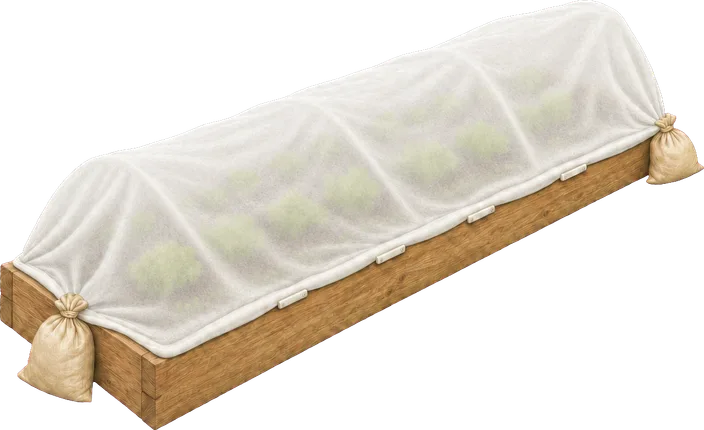
Frost is forecast for tonight and the beans are up. Pull a sheet of row cover over the bed this evening, and in the morning pull the sides up to let the air in.
Grown in Ohio, zone 6a. Your frost dates move the calendar; the signals don't. Broadfork goes by where your garden is, not its zone: frost dates for your ZIP code in the US, or the ones you type in anywhere else.
Four minutes to read. The steps stand on their own.
Before you start#
Row cover is a fabric sold by weight, in ounces a square yard. The heavier it is, the more frost it holds off and the less light it lets through. It breathes, so unlike plastic it needs no venting.
- Light
- 0.45 oz. Over 90 percent of the light gets through, and it holds off about 2 °F of frost. Mostly it's used against insects.
- Medium
- 0.5 to 1.0 oz. 70 to 85 percent of the light, about 4 to 6 °F. The spring and fall cover.
- Heavy
- 1.5 to 2.2 oz. Only 30 to 50 percent of the light, about 8 °F. For brief cold snaps at either end of the season, not for weeks.
Go by the ounces, not the grade name. The names don't line up across the data: a 1.0 oz cover is medium by one count and heavy by another.
Most covers hold to somewhere between 24 and 28 °F, and the heaviest to about 20. For a colder night, lay a second layer or use a heavier grade.
Buy it wider than the bed. A 6-foot roll covers a 3-foot bed with slack for the plants to grow up under it.
The steps#
- Cover the bed in the evening. On a frost night it goes on before dark. The next day you don't have to take it off: pull the sides up to let the air in.
- Hold it off the leaves. Wire hoops pushed into the soil keep the fabric up. Where frost cloth touches a leaf, the leaf can freeze.
- Put it on while the wind is down, with slack. Leave enough that the plants can grow up under it.
- Bring it to the ground on every side. Weight the edges with soil, boards, bricks or sandbags. A gap lets the wind under it and the warmth out.
- Uncover, or pull the sides up, in the sun once it's above 55 °F. That's the rule for cool-season crops; close it again in the evening when the nights drop into the 30s.
- Take it off for good when squash, cucumbers and melons bloom. The bees have to reach the flowers. Tomatoes and peppers come out from under when they start to flower too.
In Broadfork Frost cloth on a tunnel over a bed shows each planting under it how far the cover may stretch its season, as an estimate that assumes the cover is on properly.
Leaves and heat#
Some of the data lays row cover right on the crop, with slack for the plants to grow. On a cold night, hold it up off the leaves instead: that's where they freeze.
In summer sun, the air under row cover runs 5 to 15 °F hotter than outside.
Above 90 °F, tomatoes, peppers and beans drop their flowers. On a hot day, peel the sides back.
Most covers stay on a month or less. Heavy ones are done by early June, and so are greens and the cabbage family.
Against insects#
The light grade doubles as an insect barrier. It isn't insect netting: netting is a separate mesh, its holes sized to the pest it has to stop.
Put it on before the pests show, and seal every side with soil: anything already in the soil or on the plants is trapped under it. The times that matter most are early spring and again late July into early August.
It keeps aphids, cutworms and flea beetles off tomatoes and peppers; cucumber beetles, squash bugs and squash vine borers off squash and cucumbers; and cabbage worms, loopers and cabbage maggots off the cabbage family.
If it goes wrong#
- Blew off in the night
- Weight it all the way around, and lay it while the wind is down. On a windy site, keep each length short.
- Leaves frozen where it touched
- Hold it off the plants with wire hoops.
- Flowers dropped on a hot day
- It ran past 90 °F under there. Peel the sides back on warm days.
- Flowers but no squash
- The bees couldn't reach them. Uncover at bloom.
- More pests under it than out
- They were already there when it went on. Cover before the pests show, and seal the sides.
- Torn
- Staples tear it. Weight the edges instead of pinning them.
Every number on this page comes from a published extension source.
Sources for this guide: USDA, Utah State University Extension, Colorado State University Extension, NC State Extension, New Mexico State, University of Georgia Extension, University of Maryland Extension, University of Minnesota Extension, University of New Hampshire Extension, University of Wisconsin-Madison Division of Extension, WVU Extension.
The documents behind this guide (13)
- Low Tunnel Systems (2023), USDA
- NRCS, OH (2023), USDA
- Mulches and Row Covers, Utah State University Extension
- Row Covers (2020), Utah State University Extension
- Frost Protection and Extending the Growing Season (2023), Colorado State University Extension
- Season Extenders and Greenhouses (2022), NC State Extension
- for educational purposes (2019), New Mexico State
- Low hoop houses can extend the growing season (2023), University of Georgia Extension
- Vegetable Garden Weather and Pest Protection (2026), University of Maryland Extension
- Extending the growing season: start early, end later (2024), University of Minnesota Extension
- Using Row Covers in the Garden (2020), University of New Hampshire Extension
- Extending the Garden Season (2009), University of Wisconsin-Madison Division of Extension
- Low Tunnels for Beginners (2023), WVU Extension
Updated 11/11/2026 · Checked against our sources 11/12/2026