
Crop guide
Cucumbers
Cucumbers go in once the frost is past and the soil is warm. Then pick every two or three days, or the plant slows down.
Grown in Ohio, zone 6a. Your frost dates move the calendar; the signals don't. Broadfork goes by where your garden is, not its zone: frost dates for your ZIP code in the US, or the ones you type in anywhere else.
Nine minutes to read. Each section stands on its own.
- What you plant
- Seed sown where it will grow, or a transplant in a pot planted with it.
- When
- After the last frost, once the soil is at least 60 °F; some data waits for 70.
- How deep
- 1/2 to 1 inch; the data splits between the two.
- How far apart
- 8 to 12 inches apart in the row, the data running to 18, and rows 4 to 6 feet apart, some data as close as 2. In hills, 2 or 3 plants, hills 3 to 6 feet apart. On a trellis, 9 to 12 inches. The app plants 2 per square foot, 8 inches apart.
- Sun and soil
- Full sun, at least 6 hours and 8 to 10 if you can, in well-drained soil rich in organic matter.
- Frost
- Tender: a light frost kills it. It grows best at 75 to 85 °F.
- Family
- Cucurbitaceae, the gourd family, with squash, pumpkins and melons. It doesn't cross with any of them.
- Harvest
- By size, dark green and firm, before it yellows: slicers at 6 to 8 inches, picklers at 2 to 4. The first come 50 to 70 days from sowing.
- Soil pH
- 6.0 to 6.5; one source runs from 5.8 to 6.8.
- springSow after the last frost, once the soil reaches 60 °F.
- summerTake the covers off at the first flowers.
- summerFirst picking 50 to 70 days from sowing, then every 2 to 3 days.
- summerSow again about July 1.
- fallThe first frost ends it.
Planting#
Wait for warm soil: at least 60 °F, and some data waits for 70 at 1 inch down. Sow 1/2 to 1 inch deep, a few seeds together, and keep the bed moist; seedlings come up in 7 to 14 days. Thin with scissors, not by pulling.
The data splits on seed or transplants. One source recommends sowing in place; others say transplants can cut the young plants' exposure to cucumber beetles, and bear about 2 weeks sooner.
For transplants, sow 2 or 3 seeds in a plantable pot 3 to 4 weeks before the last frost; the data runs from 10 days to 6 weeks. Thin to one, plant the whole pot at 2 to 4 true leaves, and harden them off first, never below 55 °F.
Black plastic mulch warms the soil for an earlier crop, more so under a row cover. Hold straw or compost mulch until the soil passes 75 °F: it slows warming.
Sow again around July 1: plantings made after mid-June meet fewer beetles. The last practical sowing given is July 10.
In Broadfork On a cucumber row, Plant again opens the add form for the same cucumber, dated three weeks on.
Short season Where the season is short, the soil may not reach 70 °F until late May. Plastic mulch and a row cover let seed or plants go out 2 to 3 weeks before the last frost.
Mild winter Where winters are mild, cucumbers get a spring and a fall season, the fall one sown from mid-July into September. The warmest places grow them September through February.
The season in between#
Give them about 1 inch of water a week, the data running to 2, and keep it steady while the fruit sets: short water makes bitter, misshapen fruit. Water at the soil. A morning wilt means they're dry; an afternoon wilt in heat is normal.
Keep out of wet vines, since handling them spreads disease, and don't move the vines: they root at the joints.
With no soil test, work in 1 to 2 pounds of 10-10-10 per 100 square feet. Side-dress with nitrogen; the data puts it anywhere from before the vines run to a week after the first flowers. Too much gives vine, not fruit.
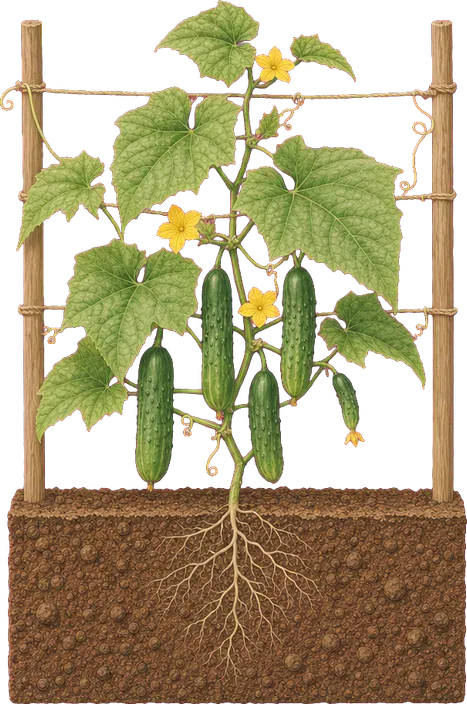
A trellis gives straighter, cleaner fruit, more of it per square foot, and easier picking. Make it 3 to 4 feet tall; some data goes to about 6. Sow 4 to 5 seeds a foot along it and thin to 9 to 12 inches.
A row cover keeps cucumber beetles off young plants. Take it off when the flowers open, so bees can reach them, or once the air under it passes 90 °F. A seedless, parthenocarpic kind needs no bees, so its cover can stay on.
The first 10 to 20 flowers are male and drop, and fruit follows within a few weeks. Spray nothing but soap or oil during bloom. Above 90 °F by day and 70 at night, the flowers run male and the bees slow down.
In Broadfork Where a hot stretch is likely to reach a cucumber row, the app says so ahead of time, with the likely dates, and that picking may thin after it.
Harvest#
Pick by size: slicers at 6 to 8 inches, picklers at 2 to 4, burpless up to 10, dark green and firm.
Pick every 2 to 3 days; some data says every other day, and daily in heat or for picklers. Take the oversized ones too: one left on the vine stops the plant setting more.
Cut the stem 1/4 inch above the fruit; some data snaps it off along the vine instead. Pick early in the morning, once the dew is off.
Plan on 2 to 3 plants a person to eat fresh and 3 to 5 more for pickles.
Storing#
Store them at 50 to 55 °F and 90 to 95 percent humidity for 10 to 14 days; some data says 45 to 50 °F, for about a week. In the refrigerator they keep about a week; one source says 3 days.
Colder hurts them: several days at refrigerator temperature brings sunken spots. In one trial, cucumbers held at 41 °F pitted from 9 days on.
Keep them away from apples, which yellow them.
For fermented dills, pick at about 4 inches, figure 4 pounds to a gallon crock, and slice 1/16 inch off the blossom end. Slicers can turn out mushy as pickles.
For seed, leave a fruit on the vine until it turns yellow or orange, then several weeks more. Save your own seed has the rest.
Which cucumbers#
Slicers are long and dark green; picklers are short and blocky, with bumpy, spiny skin. Burpless slicers are thin-skinned and bred without the bitterness behind the burp, 10 to 12 inches long and curved unless they climb.
Bush kinds, such as Salad Bush and Spacemaster, fit a small garden, in hills 2 to 3 feet apart.
Gynoecious hybrids, such as General Lee and Calypso, bear mostly female flowers and fruit early and heavily, but need pollen: the packet holds seed of a standard variety to plant with them. Parthenocarpic kinds, such as Diva, need none.
Sweet Slice, Sweet Success and Marketmore 76 rarely turn bitter. County Fair and Little Leaf H-19 resist bacterial wilt.
In the app's catalog, among others: Marketmore 76, Straight Eight, Diva, Sweet Success, County Fair and Boston Pickling.
Short season Where the season is short, grow them through clear plastic mulch and choose kinds that take cool weather, such as Corinto.
Mild winter Where winters are mild, the mildews are worst in the warmest months, so grow a kind bred to resist them.
What goes wrong#
- Cucumber beetles: yellow, about 1/5 inch, with three black stripes or 12 black spots, chewing seedlings, stems, flowers and fruit. Striped ones lay from mid-May; spotted ones arrive in midsummer. Cover the planting until bloom, lay thick straw at the base, and knock beetles into soapy water.
- Bacterial wilt: leaves wilt by day and recover at night, then the vine dies in 7 to 14 days. Beetles carry it, and nothing cures it. Cut a wilted stem, touch the cut ends together and pull them apart: strings of ooze mean wilt, though their absence doesn't clear it. Pull the plant at once.
- Powdery mildew: white powder on the leaves from midsummer, worst on late plantings. Grow a resistant variety, give the plants air, and throw mildewed vines out rather than composting them.
- Downy mildew: angular yellow spots between the veins, gray fuzz beneath, spreading fast in warm, wet weather. Nothing cures it once it shows: grow a resistant variety and water with drip.
- Mosaic virus: mottled leaves on stunted plants, and blotchy, bitter fruit. Grow resistant varieties.
- Bitter fruit: stress, from heat, drought, uneven water, swings of more than 20 °F, low fertility or low pH. Most data puts it in the stem end and just under the peel, one source in the blossom end; cut off the stem end and peel. Melons don't cause it: cucumbers can't cross with them.
- Misshapen fruit, or flowers and no fruit: poor pollination, from cool, wet weather, sprays at bloom, or an all-female variety with no pollenizer. Dry soil and low fertility misshape fruit too.
- Aphids under the leaves, and spider mites in hot, dry weather: a strong spray of water, or insecticidal soap.
In Broadfork When a cucumber goes in, the app puts bug netting on your list for that day, and asks you to take it off at bloom.
Mild winter Where winters are mild, pickleworms bore into the fruit, and the mildews are at their worst in the warmest months.
Where it goes next year#
After cucumbers, keep the family, squash, pumpkins and melons included, out of the bed for 3 to 4 years: rotation helps against leaf spots and anthracnose. Bacterial wilt lives in the beetle, not the soil.
At season's end, clear the vines, debris and mulch, where striped beetles winter. Mildewed vines go in the trash; the data splits on wilted ones.
Once the bed is empty, cover the soil.
Every number on this page comes from a published extension source.
Sources for this guide: University of Maryland Extension, University of Minnesota Extension, Ohio State University Extension, Clemson Cooperative Extension, Iowa State University Extension and Outreach, NDSU Extension, University of Georgia Extension, University of Illinois Extension, University of Nebraska–Lincoln Extension, Utah State University Extension, Virginia Cooperative Extension, Alabama Cooperative Extension System, Cornell Cooperative Extension, SDSU Extension, Texas A&M AgriLife Extension, UMass Extension, University of Alaska Fairbanks, Colorado State University Extension, Mississippi State University Extension, Montana State, Penn State Extension, Purdue Extension, University of California, University of Connecticut, University of Florida, University of Missouri Extension.
The documents behind this guide (69)
- Bacterial Wilt of Vegetables (2023), University of Maryland Extension
- Cucumber Beetles: Spotted or Striped on Vegetables (2024), University of Maryland Extension
- Downy Mildew of Vegetables (2023), University of Maryland Extension
- Growing Cucumbers in a Home Garden (2023), University of Maryland Extension
- Key to Common Problems of Cucumbers (2024), University of Maryland Extension
- Pollination Problems of Vegetables (2023), University of Maryland Extension
- Poor Blossom and Fruit Set of Vegetables (2023), University of Maryland Extension
- Powdery Mildew on Vegetables (2023), University of Maryland Extension
- Winterizing the Vegetable Garden and Composting (2025), University of Maryland Extension
- Bacterial wilt of cucurbits (2022), University of Minnesota Extension
- Cucumber beetles (2026), University of Minnesota Extension
- Growing cucumbers in home gardens (2026), University of Minnesota Extension
- Growing melons in the home garden (2026), University of Minnesota Extension
- Growing pumpkins and winter squash in home gardens (2026), University of Minnesota Extension
- Growing summer squash and zucchini in home gardens (2024), University of Minnesota Extension
- Powdery mildew of cucurbits (2026), University of Minnesota Extension
- Cucumber Beetles in Cucurbits: Identification, Damage, and Strategies for Control (2026), Ohio State University Extension
- Growing Giant Pumpkins in the Home Garden (2023), Ohio State University Extension
- Growing Muskmelons in the Garden (2018), Ohio State University Extension
- Making Fermented Dill Pickles (2016), Ohio State University Extension
- Seeds: Come And Get 'Em! (2024), Ohio State University Extension
- Squash Vine Borer Damage and Management: What to Look for and When to Act (2026), Ohio State University Extension
- Cucumber (2023), Clemson Cooperative Extension
- Cucumber, Squash, Melon and Other Cucurbit Diseases (2025), Clemson Cooperative Extension
- Cucumber, Squash, Melon and Other Cucurbit Insect Pests (2025), Clemson Cooperative Extension
- Planting Depth (inches) (2021), Clemson Cooperative Extension
- Growing Cucumbers in the Home Garden (2023), Iowa State University Extension and Outreach
- How do gynoecious cucumber varieties differ from other varieties? (2024), Iowa State University Extension and Outreach
- Why are my cucumbers flowering but not producing fruit? (2024), Iowa State University Extension and Outreach
- Why are some of my cucumbers misshapen? (2024), Iowa State University Extension and Outreach
- Field to Fork: Cucumbers (2026), NDSU Extension
- Growing cucumbers on a trellis (2024), NDSU Extension
- Putting the garden to bed (2022), NDSU Extension
- 2025 Postharvest Pitting Disorder Incidence in Cucumbers (2026), University of Georgia Extension
- Commercial Production of Vegetable Transplants (2023), University of Georgia Extension
- Growing Cucumbers in the Home Garden (2024), University of Georgia Extension
- Cucumber, University of Illinois Extension
- Put your garden to bed with fall/winter cover crops! (2021), University of Illinois Extension
- When to Plant (2025), University of Illinois Extension
- Bitterness in Cucumbers and Zucchini (2019), University of Nebraska–Lincoln Extension
- Vegetable Garden Seed Storage and Germination Requirements, G2090 (2011), University of Nebraska–Lincoln Extension
- Weird Squash: Pollination Gone Wrong? (2022), University of Nebraska–Lincoln Extension
- Harvest and Storage of Vegetables and Fruits (2015), Utah State University Extension
- How to Grow Cucumber in Your Garden (2020), Utah State University Extension
- Row Covers (2020), Utah State University Extension
- Cucumbers, Melons and Squash (2026), Virginia Cooperative Extension
- Fall Vegetable Gardening (2026), Virginia Cooperative Extension
- Mulching: Purpose, Benefits, and Essential Information (2025), Virginia Cooperative Extension
- Bitter Cukes (2021), Alabama Cooperative Extension System
- Vegetable Seasons in Alabama (2025), Alabama Cooperative Extension System
- Cucumber and Cantaloupe Varieties Resistant to Downy Mildew (2022), Cornell Cooperative Extension
- Disease-resistant cucurbit varieties (2022), Cornell Cooperative Extension
- Cucumbers: How to Grow It (2024), SDSU Extension
- Saving Seed of Pumpkins, Squash, Cucumbers, Melons and Gourds (2019), SDSU Extension
- Easy Gardening: Mulching (2014), Texas A&M AgriLife Extension
- Texas Home Vegetable Gardening Guide, Texas A&M AgriLife Extension
- Cucurbits, Bacterial Wilt (2013), UMass Extension
- Cucurbits, Powdery Mildew (2021), UMass Extension
- Recommended Variety List for Interior Alaska (2022), University of Alaska Fairbanks
- Recommended Variety List for Southcentral Alaska (2019), University of Alaska Fairbanks
- Cucumbers, Pumpkins, Squash, and Melons (2025), Colorado State University Extension
- Cucumbers, Mississippi State University Extension
- Fall Garden Care and Winter Preparation Checklist (2021), Montana State
- Cucumber Production (2018), Penn State Extension
- Home Gardener's Guide (2026), Purdue Extension
- Saving Seeds, University of California
- Cucurbits: Cucumbers and Squash (2016), University of Connecticut
- Cucumbers, University of Florida
- Planning and planting guides (2017), University of Missouri Extension
Updated 11/11/2026 · Checked against our sources 11/12/2026