
Crop guide
Tomatoes
Tomatoes go out once the frost is done and the soil has warmed. Set them deep, give them something to climb, and keep the water even.
Grown in Ohio, zone 6a. Your frost dates move the calendar; the signals don't. Broadfork goes by where your garden is, not its zone: frost dates for your ZIP code in the US, or the ones you type in anywhere else.
Eight minutes to read. Each section stands on its own.
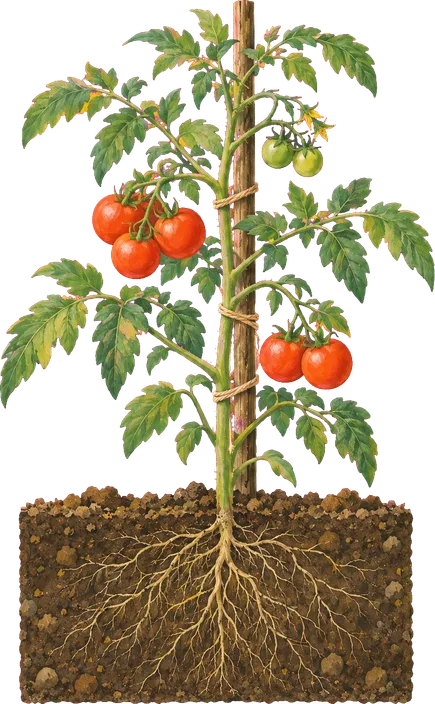
- What you plant
- A transplant, stocky, with a pencil-thick stem and no flowers or fruit. Start your own 5 to 8 weeks ahead.
- When
- After the last frost, once the soil is about 60 °F.
- How deep
- Deep, with the stem buried to the first leaves. A leggy plant goes on its side in a trench about 5 inches deep.
- How far apart
- Staked, 2 feet apart in rows 3 to 4 feet apart; caged, 2.5 to 3 feet, rows 4 to 5 feet. The app spaces them 18 inches apart.
- Sun and soil
- At least 6 to 8 hours of direct sun. Deep, loamy soil that drains, with organic matter worked in.
- Frost
- Tender. Frost kills it, and growth stalls below 50 °F.
- Family
- Solanaceae, the nightshades, with peppers, potatoes and eggplant.
- Harvest
- Firm and fully colored, before it softens. About 40 to 50 days from fruit set to mature green.
- Soil pH
- 6.5 to 6.8 by the tightest figure; the data runs as wide as 5.5 to 7.5.
- winterStart seed indoors, 5 to 8 weeks before setting out.
- springHarden off, about ten days.
- springSet out after the last frost, in soil about 60 °F.
- summerMulch once the soil is warm.
- summerFeed beside the row when the first fruit sets.
- summerRipe from 40 to 50 days after fruit set.
- fallTop the plants a month before the first frost.
- fallBring in the green fruit before the frost.
Starting and buying plants#
Start seed indoors 5 to 8 weeks before you set plants out; the data runs from 4 to 10, and starting earlier doesn't bring an earlier crop.
Sow 1/8 to 1/4 inch deep in a seed-starting mix and keep it at 75 to 85 °F until the seedlings come up, then about 70 °F. They come up in 6 to 12 days.
Give them strong light, days under 80 °F and nights above 50, or they stretch tall and spindly.
To buy, pick stocky, dark green plants with a pencil-thick stem. The data splits on one already in flower: pinch the flowers off, or pass it by.
Planting#
Set them out after the last frost, once the soil is about 60 °F. Too early and they stall in the cold.
Harden them off for about ten days first, and plant on a calm, cloudy day or in the evening.
Plant deep, the stem buried to the first leaves, where it roots; one source keeps them at pot depth for air to the roots. A leggy plant goes in a trench about 5 inches deep, at an angle, with the top 5 to 6 inches showing.
Water each one in with about a cup of a high-phosphorus starter fertilizer, and wrap a paper collar round the stem, 2 inches above the soil and 1 inch below, against cutworms.
Put the stakes or cages in now, before the roots spread.
Short season Where the season is short, planting runs from Memorial Day to early June, mid June in frost pockets. Choose varieties that ripen early, and lay black plastic to warm the soil.
Mild winter Where winters are mild, plant in March or April and again in July for a fall crop. Time the fall planting back from the first freeze: 12 to 14 weeks ahead where it's warmest.
The season in between#
Water about 1 to 1.5 inches a week, at the roots and in the morning; the data runs up to 2. Keep it even once the fruit sets, since swings bring blossom-end rot and cracked fruit.
Once the soil has warmed, around early June, lay 2 to 3 inches of straw or other weed-free mulch. Put it down earlier and it keeps the soil cold.
Mild winter Where it's warm, mulch soon after you plant.
Feed by a soil test, or 2 to 3 pounds of a complete fertilizer per 100 square feet before planting, then a little nitrogen beside the row, watered in, once the first cluster sets fruit. Too much nitrogen makes a big plant and little fruit.
Stakes stand 6 to 8 feet tall, a foot into the ground and about 4 inches from the plant; tie the stem loosely in a figure eight. A cage needs openings at least 6 by 6 inches to reach through. Staked plants ripen earlier; caged ones bear more.
Suckers are the shoots between the stem and a leaf. Take only those below the first fruit cluster on a determinate, and all of them weekly on a staked indeterminate; caged plants keep theirs.
About a month before the first fall frost, cut the top 4 inches off indeterminate plants so they finish the fruit they have.
Harvest#
Pick when the fruit is firm and fully colored, before it softens.
Above about 86 °F the red won't form, so in a hot spell pick as the color starts and finish them indoors at 70 to 75 °F.
Before the first fall frost, bring in every fruit worth keeping. A green one fading to white or pink, or with a pale star on the bottom, will ripen; one still fully green on the bottom won't be worth it. Don't eat fruit that has been frosted.
Short season Where the season is short, a plastic tunnel or row cover carries the harvest a few weeks past the first light frost. Open it by day so the plants don't overheat.
Ripening and storing#
Keep ripe tomatoes on the counter, out of the sun, where they hold 1 to 2 weeks at 50 to 55 °F. Don't refrigerate them: below about 54 °F the flavor and texture go. Some sources let fully ripe fruit into the refrigerator for a few days or longer.
Ripen green fruit in a single layer, wrapped in paper, at 60 to 65 °F, checking each week. Warmth matters, light doesn't.
Which tomato#
Determinate plants grow to a set height and ripen their fruit within a few weeks: good for canning and for cages. Indeterminate plants keep growing and fruiting until frost and need tall stakes or cages; some reach 8 feet.
Slicers for eating fresh, paste types for sauce and canning, and cherry and grape types, the easiest of all. Letters after a name on the tag mean disease resistance: V and F for the wilts, N for nematodes, T for mosaic virus. Resistant isn't immune.
Hybrids are vigorous and uniform; heirlooms can taste better but often yield less and catch more disease. Seed saved from a hybrid won't come true.
Mild winter Where summers run hot, most early varieties are determinate and won't bear all summer, and cherry types stand the heat best.
In the app's catalog, among others: Brandywine, Cherokee Purple, Early Girl, Celebrity and San Marzano.
What goes wrong#
- Blossom-end rot: a dark, sunken, leathery patch on the bottom of the first fruit. Calcium isn't reaching it, mostly from uneven water: keep the water even, mulch, and go easy on nitrogen.
- Flowers drop without setting fruit: nights below 55 °F, or days above 90 to 95 with nights above 75.
- Early blight and Septoria leaf spot: spots on the lowest leaves, with target rings or pale centers, climbing the plant. Mulch, water at the base, take off the spotted lower leaves, and keep tomatoes and peppers off that ground for two years. Most gardens don't need a spray.
- Late blight: oily patches that go brown-black and kill the plant within 7 to 10 days of cool, wet weather. Pull it, bag it, never compost it.
- Wilt: the lower leaves yellow and wilt, working upward. Sprays don't help; grow resistant varieties and keep tomatoes off that ground 4 to 6 years.
- Hornworms: big green caterpillars up to 4 inches long, with a horn at the tail. Pick them into soapy water; leave any carrying white cocoons, which are wasps at work.
- Cutworms cut young plants off at the soil, and flea beetles riddle the leaves: a paper collar at planting, and row cover over hoops for the first 2 to 3 weeks.
Where it goes next year#
Tomatoes share a family with peppers, potatoes and eggplant. Keep all of them out of a bed for three years before tomatoes go back; the data runs from two years to four, and 4 to 6 where wilt has struck.
When the plants are out, take the debris off the bed and cover the soil for winter.
In Broadfork The bed's rotation card counts the rest years for you and says which families are clear to go back in.
Every number on this page comes from a published extension source.
Sources for this guide: University of Minnesota Extension, University of Missouri Extension, Ohio State University Extension, Iowa State University Extension and Outreach, Purdue Extension, University of Illinois Extension, University of Wisconsin-Madison Division of Extension, Clemson Cooperative Extension, Michigan State Extension, NC State Extension, NDSU Extension, Penn State Extension, Texas A&M AgriLife Extension, University of Florida, University of Georgia Extension, University of Nebraska–Lincoln Extension, University of New Hampshire Extension, University of Vermont Extension, Virginia Cooperative Extension, WVU Extension.
The documents behind this guide (34)
- Early blight in tomato and potato (2024), University of Minnesota Extension
- Growing tomatoes in home gardens (2024), University of Minnesota Extension
- Harvesting and storing home garden vegetables (2026), University of Minnesota Extension
- Tomato disorders (2022), University of Minnesota Extension
- Tomato hornworms (2020), University of Minnesota Extension
- Tomato leaf spot diseases (2018), University of Minnesota Extension
- Fresh Market Tomatoes (2026), University of Missouri Extension
- Growing Home Garden Tomatoes (2022), University of Missouri Extension
- Vegetable Gardening (2017), University of Missouri Extension
- Vegetable Harvest and Storage (2026), University of Missouri Extension
- Growing Peppers in the Home Garden (2017), Ohio State University Extension
- Growing Tomatoes in the Home Garden (2017), Ohio State University Extension
- The Scourge of Vegetable Gardens: Early Blight of Tomato (2015), Ohio State University Extension
- Growing Tomatoes in the Home Garden (2024), Iowa State University Extension and Outreach
- Planting and Harvesting Your Vegetable Garden (2025), Iowa State University Extension and Outreach
- Home Gardener's Guide (2026), Purdue Extension
- Tomatoes (2026), Purdue Extension
- Tomato, University of Illinois Extension
- When to Plant (2025), University of Illinois Extension
- Homegrown Tomatoes for Wisconsin (2017), University of Wisconsin-Madison Division of Extension
- Using Crop Rotation in Home Vegetable Garden (2012), University of Wisconsin-Madison Division of Extension
- Tomato (2022), Clemson Cooperative Extension
- Michigan Fresh: Growing Tomatoes (2012), Michigan State Extension
- Growing Tomatoes in the Home Garden (2026), NC State Extension
- Tomato Varieties for North Dakota (2021), NDSU Extension
- Tomato Diseases and Disorders in the Home Garden (2025), Penn State Extension
- Texas Home Vegetable Gardening Guide, Texas A&M AgriLife Extension
- Florida Vegetable Gardening Guide (2024), University of Florida
- Georgia Homegrown Tomatoes (2021), University of Georgia Extension
- Leaf and Fruit Diseases of Tomatoes (2011), University of Nebraska–Lincoln Extension
- Growing Vegetables: Tomatoes [fact sheet], University of New Hampshire Extension
- Tips for Growing Great Tomatoes (2023), University of Vermont Extension
- Mulching: Purpose, Benefits, and Essential Information (2025), Virginia Cooperative Extension
- Growing Tomatoes in West Virginia, WVU Extension
Updated 11/11/2026 · Checked against our sources 11/12/2026