
Crop guide
Potatoes
Potatoes go in early, while the soil is still cool. Plant certified seed, hill the stems as they grow, and dig once the vines have died back.
Grown in Ohio, zone 6a. Your frost dates move the calendar; the signals don't. Broadfork goes by where your garden is, not its zone: frost dates for your ZIP code in the US, or the ones you type in anywhere else.
Eight minutes to read. Each section stands on its own.
- What you plant
- Seed pieces: small whole potatoes, or cut pieces of about 2 ounces, from certified disease-free seed potatoes, not grocery potatoes.
- When
- Two to three weeks before the last frost, once the soil is at least 45 °F. Some sources wait for 50.
- How deep
- About 4 inches; the data runs from 1 to 6. Soil is hilled over the stems as they grow.
- How far apart
- 10 to 12 inches apart in rows 30 to 36 inches apart; closer makes smaller potatoes. The app spaces them 10 inches apart.
- Sun and soil
- At least 6 hours of direct sun. Loose soil that drains, on the acid side.
- Frost
- Semi-hardy. It goes in before the last frost; a frost can blacken the shoots, but the plant grows back within 10 to 14 days.
- Family
- Solanaceae, the nightshades, with tomatoes, peppers and eggplant.
- Harvest
- To store, about two weeks after the vines die on their own. New potatoes about 7 to 8 weeks after planting.
- Soil pH
- 6 to 6.5, and they take soil as acid as 5. Where scab is a problem, the data goes down to 5.0 to 5.2 and adds no lime.
- springCut the seed and let the cuts heal for a few days.
- springPlant 2 to 3 weeks before the last frost, in soil at least 45 °F.
- springHill the stems at about a foot tall, and again two or three weeks on.
- summerNew potatoes, 7 to 8 weeks after planting.
- summerCut back the water as the vines yellow and die.
- fallDig about two weeks after the vines die, before a hard frost.
- fallCure about two weeks, then store cold and dark.
Seed potatoes#
Plant certified disease-free seed potatoes, not grocery potatoes, and don't keep seed more than a year.
Plant small ones whole. Cut big ones into pieces of about 2 ounces, the size of a hen's egg, each with at least one eye; two or three is better. More eyes make more, smaller potatoes.
Let the cuts heal before planting: a few days at 60 to 70 °F, somewhere humid. The data runs from one day to a week. A healed piece holds up better in cold, wet soil.
Warming the seed to 50 to 65 °F before you cut it gets the sprouts started.
Planting#
Plant 2 to 3 weeks before the last frost, once the soil is at least 45 °F; some sources wait for 50.
Set the pieces cut side down, eyes up, about 4 inches deep; the data runs from 1 inch to 6.
They come up one to three weeks later, sooner in warmer soil.
Short season Where the season is short, plant up to two weeks before the last frost, once the soil reaches 45 °F. Grow early varieties: later ones need 100 days or more from emergence.
Mild winter Where winters are mild, potatoes are a winter and early spring crop, mostly planted between January and March. Some warm places plant again in late summer for fall, about 110 days before the first frost, from small uncut seed that resists rot in the heat; others advise against a fall crop.
The season in between#
Water about 1 inch a week, soaking the soil, and more often in sand; the data runs up to 2.
Keep the water even while the tubers form: wet and dry swings make knobby, cracked and hollow potatoes. Cut back once the vines yellow.
Before planting, work in 1 to 2 pounds of a balanced fertilizer such as 10-10-10 per 100 square feet; the data runs to 3. Side-dress a little nitrogen about four weeks after planting, as you hill. Go easy on manure, which can bring scab.
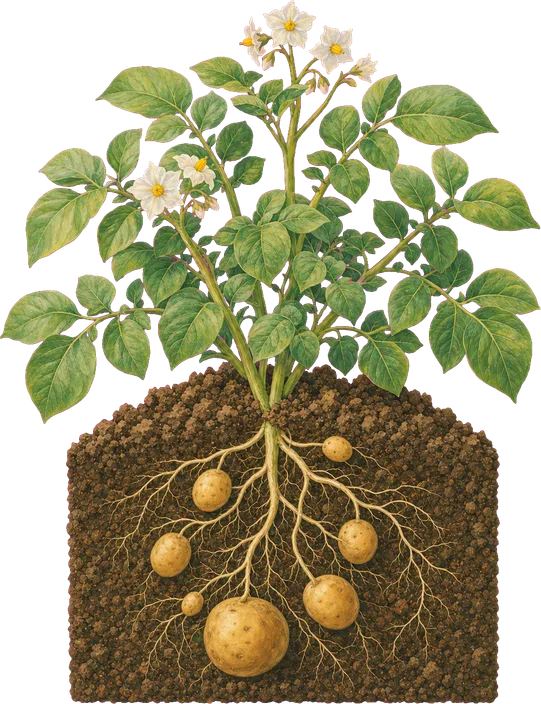
Potatoes form on the stems above the seed piece, so the soil heaped over the stems is where the crop grows. It also keeps the tubers out of the light.
Start hilling when the stems are about a foot tall, drawing soil up along the row, and again two or three weeks later: about 6 to 8 inches of soil by the end. Bury no more than 20 to 30 percent of the leaves at a time, and finish before the plants bloom or the vines fall over.
Cultivate shallow, no deeper than 2 inches, so you don't cut the tubers.
A thick straw mulch, 4 to 6 inches deep, can stand in for hilling.
A potato left in the light turns green. The green is harmless, but it comes with solanine, a bitter toxin. Cut small green patches away, and throw out a potato that is green beneath the skin.
Mild winter Where summers run hot, tubers stop forming once the soil reaches 80 °F. Straw keeps the soil about 10 °F cooler.
Harvest#
New potatoes come about 7 to 8 weeks after planting, once they're over 1 1/2 inches across. They're thin-skinned and don't keep: eat them within about ten days.
For potatoes to store, let the vines yellow and die on their own, then wait about two weeks; the data runs to three. Dig a test hill: if the skin rubs off, wait, and if it stays on, they're ready.
Dig on a dry day, with the fork 8 to 10 inches out from the plant. Soil at 50 to 65 °F bruises them less than colder soil. Brush the soil off but don't wash them, and eat the damaged ones first.
Dig before a hard frost. A light one at 30 to 32 °F does no harm, but a heavier one cuts their quality and how long they keep.
Curing and storing#
Cure them first, so the skins thicken and small cuts heal: about two weeks in the dark at 50 to 60 °F, with high humidity. The data runs from 45 to 65 °F, and from 10 days to three weeks.
Then store them dark, humid and cold, about 38 to 45 °F, in perforated bags. That keeps them for months.
Below 38 to 40 °F they turn sweet and darken when cooked, so keep them out of the refrigerator. A few days at room temperature brings the flavor back.
For potatoes you'll eat in a few weeks, 45 to 50 °F is fine.
Warmer than that, they sprout after two or three months. Keep them away from apples, whose ripening gas sets them sprouting.
A sprouted potato is still good: take off the sprouts, which carry the most solanine, and remove the eyes.
Which potato#
Varieties come early, midseason and late: early ones are ready in up to 110 days, late ones take over 120. Plant an early one for summer eating and a late one to store.
Varieties ready in under 80 days outrun the potato beetle's second generation.
Where scab is a problem, grow a resistant variety such as Superior. None is immune.
In the app's catalog, among others: Yukon Gold, Kennebec, Red Pontiac, Russet Burbank and Purple Majesty.
What goes wrong#
- Colorado potato beetle: a striped beetle about 3/8 inch long, with orange egg clusters under the leaves and humpbacked red larvae. Hand-pick adults, eggs and young larvae as soon as you see them.
- Plants can lose up to 30 percent of their leaves to the beetle before flowering, but only about 10 percent once the tubers are sizing. A row cover keeps the beetles off.
- The home sprays (Bt, spinosad, neem) work only on very young larvae, and the beetle resists many insecticides.
- Scab: rough, corky patches on the skin. Keep the soil evenly moist for 2 to 6 weeks after the tubers start to form, skip the lime and the manure, and keep the soil acid if scab has been a problem.
- Late blight: large dark blotches on the leaves with a gray-green edge, in cool, damp weather around 60 to 70 °F. Plant certified seed, keep the leaves dry, remove diseased leaves, and clear the plants out at season's end.
- Early blight: brown spots with target rings on the lower leaves, working upward. Mulch, water at the base, and take off the spotted leaves.
Where it goes next year#
Potatoes share a family with tomatoes, peppers and eggplant. Keep all of them out of a bed for three years before potatoes go back; the data runs from two years to four.
A year without potatoes only beats the beetle if every potato within a quarter to half a mile skips that year too.
Dig every tuber you can find, then cover the soil for winter.
In Broadfork The bed's rotation card counts the rest years for you and says which families are clear to go back in.
Every number on this page comes from a published extension source.
Sources for this guide: University of Minnesota Extension, Penn State Extension, Iowa State University Extension and Outreach, NDSU Extension, Ohio State University Extension, Purdue Extension, UMass Extension, University of Florida, University of Illinois Extension, University of Nebraska–Lincoln Extension, Utah State University Extension, Virginia Cooperative Extension, Clemson Cooperative Extension, Cornell Cooperative Extension, Texas A&M AgriLife Extension, University of California, University of Georgia Extension, University of Maryland Extension, University of New Hampshire Extension.
The documents behind this guide (34)
- Colorado potato beetles (2026), University of Minnesota Extension
- Early blight of tomato and potato (2024), University of Minnesota Extension
- Growing potatoes in home gardens (2026), University of Minnesota Extension
- Late blight of tomato and potato (2021), University of Minnesota Extension
- Penn State Agricultural Analytical Services Laboratory, Soil Test Recommendations for Commercial Vegetables and ... for Small Fruits, one crop recommendation sheet each (pH Goal line; PDF metadata January 2018). Index pages and .../small-fruits; crop sheets at .../vegetables/recommendations/<code>-<crop> (e.g. 1302-potatoes-home-patch, 3016-herbs) and .../small-fruits/recommendations/<code>-<crop> (3505-blueberries, 3511-brambles, 3504-grapes-american, 3506-grapes-european, 3512-strawberries-to-plant, 3513-strawberries-maintain)
- Potato Production (2023), Penn State Extension
- Potatoes in the Garden and the Kitchen (2026), Penn State Extension
- Colorado Potato Beetle Control in the Home Garden (2025), Iowa State University Extension and Outreach
- Growing Potatoes in the Home Garden (2024), Iowa State University Extension and Outreach
- From Garden to Table: My Potatoes Turned Green, Now What? (2022), NDSU Extension
- Potatoes From Garden to Table (2024), NDSU Extension
- Optimize Potato Seeding Depth and Hill Management for Your Varieties, Soils, and Markets (2023), Ohio State University Extension
- Selecting, Storing, and Serving Ohio Potatoes (2021), Ohio State University Extension
- Home Gardener's Guide (2026), Purdue Extension
- Tater Planting Time (2017), Purdue Extension
- Late Blight Management for Fall, Winter and Spring (2012), UMass Extension
- Potato Scab (2022), UMass Extension
- Growing Potatoes in the Florida Home Garden (2024), University of Florida
- Potatoes, University of Florida
- Colorado Potato Beetle, University of Illinois Extension
- Potato, University of Illinois Extension
- Planting Seed Potatoes (2022), University of Nebraska–Lincoln Extension
- Potatoes: Harvesting and Storage (2021), University of Nebraska–Lincoln Extension
- Potato: Harvest and Handling, Utah State University Extension
- Potatoes in the Garden (2020), Utah State University Extension
- Mulching: Purpose, Benefits, and Essential Information (2025), Virginia Cooperative Extension
- VCE Vegetable Gardening series, Relf & McDaniel (reviewed Olsen): 426-401 Asparagus (Feb 2026) · 426-402 Beans (2025-03-10) · 426-403 Cole Crops or Brassicas (Feb 2026) · 426-405 Sweet Corn (Feb 2026) · 426-406 Cucumbers, Melons and Squash (Feb 2026) · 426-408 Leafy Green Vegetables (Feb 2026) · 426-411 Onions, Garlic, and Shallots (Feb 2026) · 426-413 Potatoes, Peppers and Eggplant (Mar 2026) · 426-418 Tomatoes (with Morse, Mar 2026) · 426-422 Root Crops (SPES-789, 2026, read from the PDF)
- Potato (2021), Clemson Cooperative Extension
- Potato Scab (2021), Cornell Cooperative Extension
- Easy Gardening: Irish Potatoes (2014), Texas A&M AgriLife Extension
- Cultural Tips for Growing Potato (2026), University of California
- Home Garden Potatoes (2026), University of Georgia Extension
- Target pH (2021), University of Maryland Extension
- Using Row Covers in the Garden (2020), University of New Hampshire Extension
Updated 11/11/2026 · Checked against our sources 11/12/2026