
How to
Build a low tunnel
Frost is in the forecast and the tomatoes are already in. Bend a few hoops over the bed and stretch a cover across them.
Grown in Ohio, zone 6a. Your frost dates move the calendar; the signals don't. Broadfork goes by where your garden is, not its zone: frost dates for your ZIP code in the US, or the ones you type in anywhere else.
Seven minutes to read. The steps stand on their own.
Before you start#
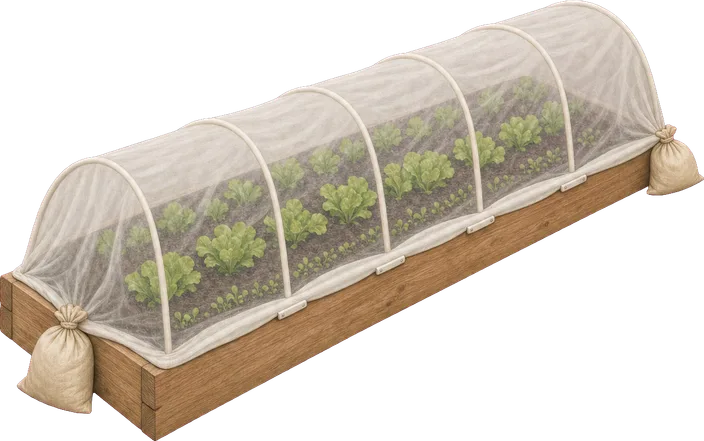
A low tunnel is a row of hoops over a bed with a cover stretched across, 2 or 3 feet tall over a bed 3 to 4 feet wide. Past 4 feet at the peak, it's a high tunnel.
It suits crops that stay under about 2 feet. Once tomatoes need cages or pole beans start to climb, the cover comes off.
It gives tomatoes, peppers and sweet corn about a two-week start in spring, and carries spinach and kale through the winter. Set it up a few weeks before you plant, closed, to warm the soil.
Put it in full sun, and run the bed with the prevailing wind.
In Broadfork A planting under a tunnel's cover shows how far that cover may stretch its season, as an estimate that assumes the cover is on properly.
Pick the cover#
- Light fabric
- 0.45 oz a square yard. Lets 90 to 95 percent of the light through and holds off about 2 °F of frost. Mostly it's for insects.
- Medium fabric
- 0.5 to 1.0 oz. 70 to 85 percent of the light, about 4 to 6 °F. The spring and fall cover.
- Heavy fabric
- 1.5 to 2.2 oz. Only 30 to 50 percent of the light gets through, so it's for overwintering and cold snaps. Good for about 8 °F; the data on how cold it holds runs from 28 down to 20 °F.
- Clear plastic
- 4 to 6 mil greenhouse film. It heats up fast in sun and has to be vented by hand.
- Insect netting
- Pick the mesh by the pest: 0.35 mm keeps out aphids, flea beetles, thrips and whiteflies; 5 by 3 mm stops only moths, stink bugs and squash bugs. Seal the edges with soil.
- Bird netting
- Netting fine enough for fruit flies also kept birds off completely. Our rows have no mesh size made for birds yet.
- Shade cloth
- Goes on the same hoops in summer, against heat and insects.
The grade names don't line up across the data: one source calls 0.50 to 0.55 oz medium and anything from 0.90 heavy, so a 1.0 oz cover is medium by one count and heavy by the other. Go by the weight, not the word.
In Broadfork A tunnel keeps its covers as layers, frost cloth under clear poly say, with the day each one went on and came off.
Size the cover#
The cover goes up one side of the hoop, over the top and down the other, so its width is the hoop's arc, not the bed's.
Over a 4-foot bed, a hoop 2 feet tall is a semicircle with 6.3 feet of arc from soil to soil. At 3 feet tall it's about 8.3.
Or measure the hoop: its length less what's in the ground is the arc. An 8-foot conduit set 6 inches deep on each side is 7 feet of arc.
Add about a foot each side to bury or weight. No source prints that as a rule; it's the middle of what the data's own covers leave, 0.5 to 2.5 feet a side. Plastic tied down by a cord over every hoop needs little or none.
For the length, add 5 or 6 feet past each end hoop to gather and tie off. The data runs from 4 to 8.
A 4-by-8 bed under hoops 2 feet tall: 6.3 feet of arc plus a foot each side is 8.3 feet wide, and 8 feet of run plus 5 at each end is 18 long. A 10-foot roll, the usual width, cut to 18 feet does it.
The steps#
- Make the hoops. Bend 10-foot electrical conduit, or use 1/2-inch PVC or 9-gauge wire. PVC lasts years under fabric but wears plastic film out within a couple; under film, use metal.
- Set one every 4 feet or so. Push the ends 6 inches into the soil, or slide PVC over rebar driven into the ground. The data runs from 3 to 5 feet; go closer where it's windy.
- Pull the cover tight. Taut, so wind can't lift it and snow can't sag it onto the crop. Tape the hoop tops so they don't tear it, and clip it to each hoop.
- Weight the sides every 3 feet or so. Sandbags, bricks, boards or soil. Leave one side easy to lift so you can get in.
- Gather each end and tie it off. Bunch the spare cover past the end hoop and tie it to a stake driven at a slant.
- Water it yourself. No rain gets under the cover, so water whenever the soil is dry.
Short season Where snow falls, set the hoops 4 feet apart, lay plastic over the row cover so the snow slides off, and brush it clear after each snowfall.
Watch the heat#
Clear plastic shut on a sunny day can pass 130 °F inside in about an hour. Keep it under 90 °F; above that, tomatoes, peppers and beans drop their flowers.
Open an end or roll up a side on warm, sunny days. Close it for the night unless the low will stay above 40 °F. A min-max thermometer inside tells you what you missed.
Fabric breathes and needs no venting. Slitted or perforated plastic vents itself but holds less frost. Solid plastic you open by hand.
Mild winter Where winters are warm, clear tunnels overheat even in spring. White plastic gives some of the gain without the worst of the heat.
If it goes wrong#
- Blew off or flapped loose
- Tighter, and more weight: a sandbag at every hoop on both sides, and the ends tied to stakes well past the last hoop. Keep runs short on a windy site.
- Leaves frozen where they touch
- Hold the cover off the plants.
- Scorched on a sunny day
- It cooked. Open it sooner, and cut slits in the top before the heat comes, not after.
- Flowers but no squash
- The bees couldn't reach the flowers. Uncover it once the female flowers open.
- More pests under than out
- They were in the soil or on the plants when the cover went on. Cover before the pests show, and seal the sides.
- A torn cover
- Staples and bare hoop ends tear it. Tape the hoop tops, and weight the edges instead of pinning them.
Taking it off#
Squash, cucumbers and melons come out from under when they start to bloom, so the bees can reach them. Or uncover them in the morning while the bees work, and cover them again for the afternoon and the night.
Most covers stay on a month or less. Greens and the cabbage family come out by early to mid June, before the heat; a cover left on all summer holds damp air and invites disease.
At the end of the season, wash the cover, dry it and store it; the hoops can stay in. Insect netting lasts 7 to 10 years if it comes down after the crop.
The exceptions, by crop#
- Tomatoes, peppers, eggplant: covered at transplanting, uncovered when they flower. The cover keeps off flea beetles and aphids.
- Squash, cucumbers, melons: covered at seeding or transplanting, uncovered when the first female flowers open. A mesh of about 0.72 by 0.97 mm kept cucumber beetles out in a trial and still let air through.
- Cabbage, broccoli, kale: netting from planting keeps off cabbage worms, loopers, flea beetles and root maggots, and flea beetles need the finest mesh, 0.35 mm. Uncover by mid June if the heat builds.
- Spinach and kale: both winter over under a tunnel. Lettuce is hard to carry through, and chard dies below 15 °F.
Every number on this page comes from a published extension source.
Sources for this guide: USDA, Colorado State University Extension, Cornell Cooperative Extension, Iowa State University Extension and Outreach, NC State Extension, New Mexico State, Oregon State University Extension, SARE, University of Florida, University of Georgia Extension, University of Illinois Extension, University of Minnesota Extension, University of New Hampshire Extension, Utah State University Extension, WVU Extension.
The documents behind this guide (16)
- Low Tunnel Systems (2023), USDA
- NRCS, OH (2023), USDA
- Frost Protection and Extending the Growing Season (2023), Colorado State University Extension
- Thinking exclusion? (2020), Cornell Cooperative Extension
- Using Low Tunnels to Extend the Season in Your Vegetable Garden (2025), Iowa State University Extension and Outreach
- Season Extenders and Greenhouses (2022), NC State Extension
- for educational purposes (2019), New Mexico State
- Copyright © 1995-2026 Oregon State University (2026), Oregon State University Extension
- Extending the vegetable growing season with low cost quick hoops (2011), SARE
- Row Covers for Growth Enhancement, University of Florida
- Low hoop houses can extend the growing season (2023), University of Georgia Extension
- Use row cover to protect plants from more than just frost (2021), University of Illinois Extension
- Extending the growing season: start early, end later (2024), University of Minnesota Extension
- Using Row Covers in the Garden (2020), University of New Hampshire Extension
- Row Covers (2020), Utah State University Extension
- Low Tunnels for Beginners (2023), WVU Extension
Updated 11/11/2026 · Checked against our sources 11/12/2026