Crop guide
Garlic
Garlic goes in after the first killing frost and comes out the next summer. One clove in, one bulb out.
Grown in Ohio, zone 6a. Your frost dates move the calendar; the signals don't. Broadfork goes by where your garden is, not its zone: frost dates for your ZIP code in the US, or the ones you type in anywhere else.
Eight minutes to read. Each section stands on its own.
- What you plant
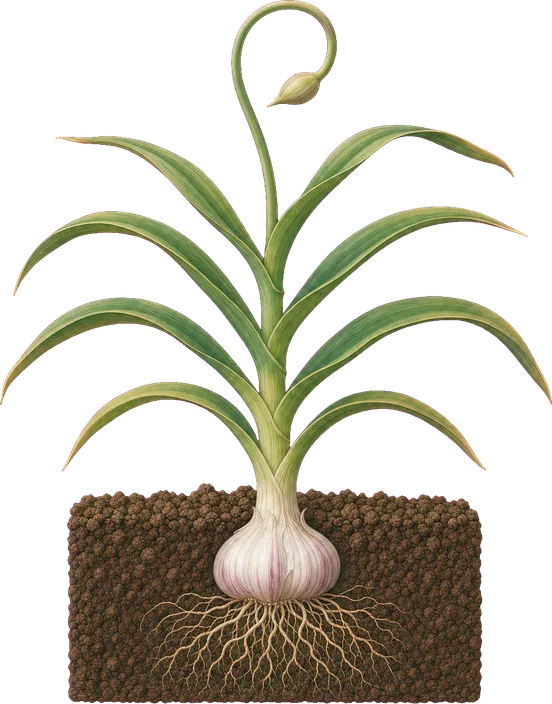
- A clove, split off a bulb a day or two before planting. Leave the papery skin on.
- When
- Fall, one or two weeks after the first killing frost. Ideally the first leaves are up before freezing weather; in a short season the shoots often stay under the soil until spring. Where winters stay mild, plant by the month instead, October to December.
- How deep
- 1 to 2 inches, pointed tip up, flat plate down.
- How far apart
- 4 to 5 inches in a bed. The app packs four to a square foot, 6 inches apart.
- Sun and soil
- Full sun. Well-drained soil with compost worked in. Keep it evenly moist.
- Frost
- Hardy. It sits in the ground all winter.
- Family
- Amaryllidaceae, with onions, leeks, shallots and chives. They share a rotation slot.
- Harvest
- June or July. The lower leaves start to yellow; dig before more than half have browned.
- Soil pH
- 6.0 to 7.0, with 6.0 to 6.5 the ideal; it tolerates up to 8.0. Test the soil every two or three years.
- fallFirst killing frost.
- fallPlant, one to two weeks after it. Straw on the same day.
- winterGround freezes. Roots down, little top.
- springGrowth resumes. Rake the straw off.
- springScapes, on hardneck.
- summerThe lower leaves start to yellow; dig before more than half have browned.
- summerCure three to four weeks.
- summerStore. Keep the biggest cloves.
Planting#
Split the bulb into cloves a day or two before you plant. Don't peel them. Plant the biggest cloves and cook the small ones.
Plant one or two weeks after the first killing frost, 1 to 2 inches deep with the pointed tip up and the flat root plate down. Space them 4 to 5 inches apart. You want roots down and the first leaves showing before freezing weather, and not much more than that.
Full sun and ground that drains. Work compost in first. Without compost, the published figure is 3 pounds of 10-10-10 per 100 feet of row.
Short season Where winters are long, planting runs from mid September to early October, still one to two weeks after the first killing frost. Data from cold climates shows the shoot should still be under the soil at the first hard freeze, and it often stays there until spring, so no leaves in fall is normal, though fall shoots are usually fine too. Plant 2 to 3 inches deep, 3 to 4 in the coldest gardens. The depth to avoid is too shallow: those cloves put up fall shoots that the winter kills.
Mild winter Garlic needs weeks of cold to make a bulb, roughly 6 to 8 below 40 °F. Where winters stay mild there's no killing frost to count from, so plant by the month: October in zone 8, November in 9a, December in 9b. The data gives no set time for chilling the cloves in the refrigerator first, and warns that long storage near 40 °F makes rough bulbs.
Winter#
Put 3 to 4 inches of clean straw or leaves over the bed the day you plant. It holds the weeds down and keeps the cloves from heaving out in a freeze and thaw. Straw, not hay. Hay carries weed seed.
The cloves root and put up a little top, then go dormant. Nothing to do until spring.
Short season Mulch deeper: 4 inches of straw is the common figure and up to 10 in the coldest gardens, and it matters most where snow cover is thin. The data splits on when: after planting, or once the ground has frozen, to stop the cloves heaving.
Mild winter Mulch is for moisture and weeds, not cold: 2 to 3 inches once the shoots are up, kept a couple of inches off the stems.
In Broadfork The straw shows up on your week's list, with the reason and the source behind it.
Spring#
When the shoots come up through the straw, rake it off the plants and leave it between the rows, or wait until the hard freezes are past. Either way, leave it on the bed as a mulch.
Hardneck garlic sends up a curling flower stalk in late spring, the scape. Snap it off so the plant puts its work into the bulb. Eat them. They taste like mild garlic and go in anything you'd put garlic in.
Harvest#
Dig once the lower leaves start to yellow, and before more than half have browned, June or July here. Wait until they're all brown and the wrappers rot or go missing, and the bulb won't keep.
Lift with a fork, not by the stem. Shake the dirt off and stop there. Don't wash them.
Short season Digging runs later: mid July into August, and as late as early September in the coldest gardens. Go by the leaves, as above.
Mild winter Digging comes earlier, often May or June. The leaves still tell you when.
In Broadfork Log the lower leaves yellowing as an observation on the planting and its harvest window moves to match.
Curing and storing#
Hang them or lay them out somewhere warm, dry and airy, out of the sun, with the stems and leaves on. Three or four weeks is the usual figure; the data runs up to six. When the outer skins are papery and the neck is dry, trim the roots and the stem.
Store cool and dry in mesh or paper, never plastic. A cured bulb keeps for months.
Set the biggest bulbs aside, and those are what you plant in the fall.
Garlic doesn't set true seed. A hardneck scape you leave on makes bulbils instead, a cluster of small cloves of the same garlic. Plant those half an inch deep in the fall and they take two years: a single round the first summer, lifted with the crop and replanted, and a full head the second.
Which garlic#
Hardneck sends the scape, has the stronger flavor and takes the cold. Softneck braids and stores longer but is less hardy. In a cold winter, plant hardneck.
Short season Grow hardneck. Data from cold climates favors it over softneck, with Rocambole, Purple Stripe and Porcelain doing well, though a few softnecks can work.
Mild winter Grow softneck. Artichoke, Silverskin and Creole types are the ones named for warm winters, and Rocambole does poorly there.
In the app's catalog, among others: Music, German Extra Hardy, Chesnok Red, Spanish Roja and Inchelium Red.
What goes wrong#
- Onion maggot. The flies come in spring. The same fly works onions, carrots and radishes.
- Onion thrips. Overhead water washes them off. Clear volunteer onions and debris.
- White rot. The one to take seriously, because its resting bodies survive in soil for 20 to 40 years and rotation alone won't clear it. Don't plant any onion-family crop in ground that has had it.
- Lost over winter. Shoots that came up in fall and froze, a sudden drop below about 10 °F with no snow or mulch over the bed, cloves heaved out by freeze and thaw, or ground that stays wet. Plant on time and not too shallow, mulch, and pick ground that drains.
- No bulb, or a small one, where winters are mild. Without weeks of cold the plant may not bulb at all, and heat above about 85 °F on dry soil can undo the chilling it had. Grow softneck, plant on time and keep the soil moist in spring; in a wet spring on heavy soil, lift before the heads rot.
- Other diseases: not in our rows yet.
Where it goes next year#
Garlic shares its family with onions, leeks, shallots and chives. Give the ground a turn with something else before another of them.
Once the bed is empty, cover the soil rather than leave it bare.
In Broadfork The bed's rotation card counts the rest years for you and says which families are clear to go back in.
Every number on this page comes from a published extension source.
Sources for this guide: Texas A&M AgriLife Extension, University of California, University of Wisconsin-Madison Division of Extension, University of Florida, University of Illinois Extension, University of Minnesota Extension, Alabama Cooperative Extension System, Clemson Cooperative Extension, Iowa State University Extension and Outreach, LSU AgCenter, Mississippi State University Extension, NDSU Extension, New Mexico State, Ohio State University Extension, Oregon State University Extension, SDSU Extension, University of Alaska Fairbanks, University of Georgia Extension, University of Kentucky Cooperative Extension, University of Maryland Extension, University of New Hampshire Extension, Virginia Cooperative Extension, Washington State University Extension.
The documents behind this guide (32)
- Easy Gardening: Mulching (2014), Texas A&M AgriLife Extension
- Fall Vegetable Gardening Guide, Texas A&M AgriLife Extension
- Garlic (2011), Texas A&M AgriLife Extension
- Cultural Tips for Growing Onions and Garlic, University of California
- Garlic: Safe Methods to Store, Preserve, and Enjoy (2016), University of California
- Seeds: Collecting & Storing (2025), University of California
- Garlic (Allium sativum) (2023), University of Wisconsin-Madison Division of Extension
- Garlic: Fall is the Time to Plant (2025), University of Wisconsin-Madison Division of Extension
- Growing onions, garlic, leeks, and other alliums in Wisconsin (2003), University of Wisconsin-Madison Division of Extension
- Fall Herbs (2025), University of Florida
- Garlic, University of Florida
- Illinois Extension: Growing Garlic infosheet (updated September 2020); green garlic from close spacing; search summary only
- Put your garden to bed with fall/winter cover crops! (2021), University of Illinois Extension
- Growing garlic in home gardens (2026), University of Minnesota Extension
- Growing Garlic in Minnesota (2023), University of Minnesota Extension
- Add Garlic to Your Garden, Alabama Cooperative Extension System
- Onion, Leek, Shallot, & Garlic (2023), Clemson Cooperative Extension
- Crop Rotation in the Vegetable Garden (Yard and Garden), Iowa State University Extension and Outreach
- Garlic in the Garden (2017), LSU AgCenter
- Mississippi Vegetable Gardener's Guide, Mississippi State University Extension
- From Garden to Table: Garlic! (2021), NDSU Extension
- Garlic Production in New Mexico (2011), New Mexico State
- Growing Garlic in the Garden, Ohio State University Extension
- Garlic (2010), Oregon State University Extension
- Garlic: How to Grow It (updated 2024-08-01)
- Growing Garlic in Alaska (2024), University of Alaska Fairbanks
- Garlic Production for the Gardener (2021), University of Georgia Extension
- University of Kentucky, NEP-241: Growing Your Own: Garlic (Olsen, Rudolph, Durham; issued 10-2024)
- White Rot of Onion and Garlic, University of Maryland Extension
- Growing Garlic in New Hampshire (2016), University of New Hampshire Extension
- Mulching: Purpose, Benefits, and Essential Information (2025), Virginia Cooperative Extension
- A Step-by-Step Guide to Saving Seeds (seed-library binder) (2024), Washington State University Extension
Updated 11/10/2026 · Checked against our sources 11/12/2026