
Crop guide
Onions
Onions go in early and take the cold. The length of the day decides when they bulb, so pick the right kind for where you live, keep the water even, and cure them well.
Grown in Ohio, zone 6a. Your frost dates move the calendar; the signals don't. Broadfork goes by where your garden is, not its zone: frost dates for your ZIP code in the US, or the ones you type in anywhere else.
Seven minutes to read. Each section stands on its own.
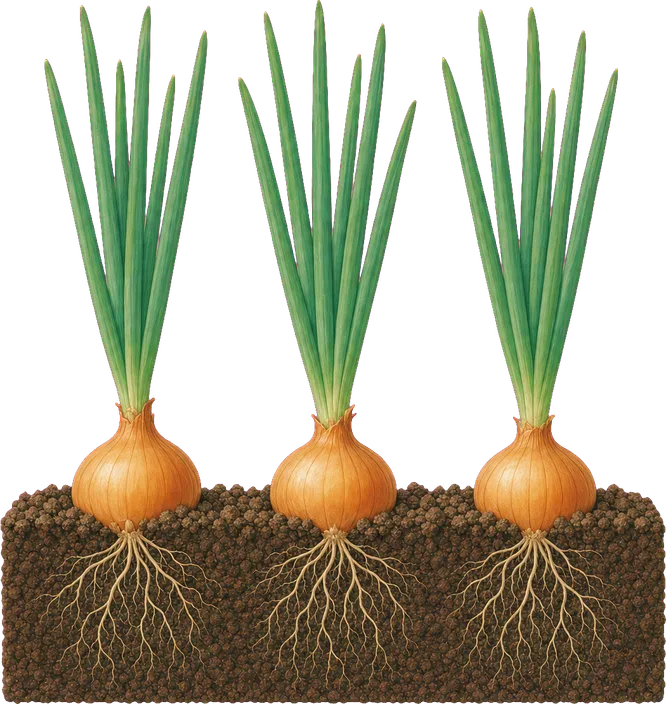
- What you plant
- Sets (small dry bulbs grown from seed the year before), transplants or seed. Sets and transplants are easier; seed is the cheapest and the most work.
- When
- Early spring, as soon as the soil can be worked: sets and seed 4 to 6 weeks before the last frost, transplants 2 to 3 weeks before.
- How deep
- Sets 1 to 2 inches, seed 1/2 inch, transplants with the roots and an inch of stem buried.
- How far apart
- 3 to 4 inches apart for storage onions, in rows 12 to 18 inches apart. The app plants 9 per square foot, 4 inches apart.
- Sun and soil
- Full sun, at least 6 hours. Loose, fertile soil that drains, with plenty of organic matter.
- Frost
- Hardy. Sets and seed take a hard frost; transplants take a light one.
- Family
- Amaryllidaceae, with garlic, shallots, leeks and chives.
- Harvest
- When about half the tops have fallen over, about 90 to 120 days after planting.
- Soil pH
- 6.0 to 6.8; the data runs up to 7.
- winterStart seed indoors, 8 to 12 weeks before setting out.
- springSets and seed out 4 to 6 weeks before the last frost, transplants 2 to 3.
- summerBulbs form as the days lengthen.
- summerStop watering when the tops start to fall.
- summerPull when about half the tops are down.
- summerCure 2 to 4 weeks, warm, shaded and airy.
- fallStore cold and dry.
Seed, sets and transplants#
Start seed indoors 8 to 12 weeks before setting out; the data runs from 4 weeks to 12.
Clip the seedlings back to 4 inches whenever they reach 5, and buy fresh seed each year.
For bulbs, plant small sets, under about 3/4 inch across. Big sets tend to bolt, so grow them for green onions.
A good transplant is about 6 inches tall and half as thick as a pencil. Bought plants come dry and keep for up to three weeks before planting.
Harden home-grown transplants for a week before they go out.
Planting#
Plant in early spring, as soon as the soil can be worked: sets and seed 4 to 6 weeks before the last frost, transplants 2 to 3 weeks before. Sets and seed take a hard frost; transplants take a light one.
Set sets 1 to 2 inches deep and seed 1/2 inch. Bury a transplant's roots and an inch of its stem.
Space storage onions 3 to 4 inches apart; big sweet onions want 4 to 6. Sets can go in 2 to 3 inches apart and be thinned, and the thinnings eaten as green onions.
Water them in and keep the bed moist until they take hold.
Short season Where the season is short, grow long-day onions; short-day ones make small bulbs there. Start seed indoors 10 to 12 weeks ahead, and set transplants out once it reaches 50 °F.
Mild winter Where winters are mild, grow short-day onions, planted in fall or winter for a spring harvest; long-day onions won't bulb there.
Mild winter A plant bigger than a pencil when the cold arrives tends to bolt in spring, so don't plant too early in fall.
The season in between#
The length of the day starts the bulb. No bulb forms until the days reach the variety's threshold, whatever the planting date.
Long-day onions bulb once days reach about 14 to 16 hours, intermediate ones about 12 to 14, short-day ones about 10 to 12. The data puts long-day as high as 16 or more.
Every leaf the plant makes before then is a ring on the bulb, so the bigger the plant when the day arrives, the bigger the onion.
An onion planted late, or of the wrong class for your garden, makes a small bulb or none.
Water about 1 inch a week, soaking the soil. The roots are shallow, so don't let it dry out. Stop once the bulbs are full size and the tops begin to fall.
Onions need more feeding than most vegetables. Work in about 2 pounds of 10-10-10 per 100 square feet before planting, then side-dress four to five weeks after planting, in a band 2 to 3 inches from the plants. Too much nitrogen makes thick necks and soft bulbs.
Their thin leaves don't shade out weeds, so weed early, above all in the first 6 to 8 weeks, and hoe shallow. A mulch of straw or clippings helps.
Don't hill bulb onions: hilled onions rot after harvest.
Harvest#
Pull them when about half the tops have fallen over; the data runs from a quarter to three-quarters. Pull gently, with the tops on, on a dry, cool day.
Green onions can be pulled any time once the tops are 6 inches tall, about 4 to 6 weeks after planting sets. They keep a week or two in a bag in the refrigerator.
Pull a bolting onion, one sending up a seed stalk, and use it right away.
Curing and storing#
Cure them for two to four weeks somewhere warm, shaded and airy, until the necks are dry and tight and the outer skins rustle; the one temperature in the data is 75 to 90 °F. Bring them in if it turns wet.
A neck that isn't fully dry lets neck rot in, and hot sun can scald them while they cure.
Then cut the tops about 1 inch above the bulb.
Store them cold and dry, 32 to 40 °F, in mesh bags or open crates; above 40 °F they start to sprout. Some sources store them at 45 to 55 °F instead, and drier.
Good keepers last several months, sweet onions only a few weeks.
Which onion#
Pick the day-length class for where you live: long-day and intermediate onions in the North, short-day ones in the South.
Sweet onions store poorly. A storage onion with a small neck keeps best.
In the app's catalog, among others: Yellow Sweet Spanish, Walla Walla, Candy, Red Wethersfield and Evergreen Bunching.
What goes wrong#
- Thrips: tiny insects, about 1/16 inch, feeding deep in the leaf folds and leaving silvery streaks. They thrive in hot, dry weather and do the most harm while the bulbs form.
- A hard spray from the hose knocks thrips down, and rain helps. Keep onions away from grain fields, alfalfa and clover.
- Onion maggots: small white larvae in the roots and bulb, worst in a cold, wet spring. A row cover from early May to the end of the month keeps the flies off, but never over last year's onion ground. Where they've been a problem, planting after June 1st misses the worst of them. Keep manure out in spring.
- Bolting: a seed stalk, brought on by days of cold once the plant is past a small size. Big sets and early planting make it likelier, and cutting the stalk off doesn't save the onion.
- Neck rot shows up in storage as soft brown scales; dry the necks fully. Basal rot yellows the tops and softens the neck; rotate, and choose resistant varieties.
Where it goes next year#
Onions share a family with garlic, shallots, leeks and chives. Keep all of them out of a bed for three to four years before onions go back.
Once the bed is empty, cover the soil rather than leave it bare.
In Broadfork The bed's rotation card counts the rest years for you and says which families are clear to go back in.
Every number on this page comes from a published extension source.
Sources for this guide: Purdue Extension, Texas A&M AgriLife Extension, University of Georgia Extension, University of Illinois Extension, University of Minnesota Extension, University of New Hampshire Extension, Utah State University Extension, Clemson Cooperative Extension, Iowa State University Extension and Outreach, NC State Extension, NDSU Extension, Ohio State University Extension, Penn State Extension, UMass Extension, University of California, University of Florida, University of Vermont Extension, Virginia Cooperative Extension.
The documents behind this guide (25)
- Effects of Cold Weather on Horticultural Plants in Indiana (2026), Purdue Extension
- Home Gardener's Guide (2026), Purdue Extension
- Easy Gardening: Mulching (2014), Texas A&M AgriLife Extension
- Onions, Texas A&M AgriLife Extension
- Fall Vegetable Gardening (2023), University of Georgia Extension
- Organic Vidalia Onion Production (2017), University of Georgia Extension
- Onion, University of Illinois Extension
- Put your garden to bed with fall/winter cover crops! (2021), University of Illinois Extension
- Cabbage and onion maggots (2022), University of Minnesota Extension
- Growing onions in home gardens (2024), University of Minnesota Extension
- Education Center Volunteers (2020), University of New Hampshire Extension
- How do I get my onions to grow bigger? (2020), University of New Hampshire Extension
- Onion Thrips (2008), Utah State University Extension
- Onions in the Garden (2020), Utah State University Extension
- Onion, Leek, Shallot and Garlic (2023), Clemson Cooperative Extension
- All About Onions (2024), Iowa State University Extension and Outreach
- Bulb Onions (2025), NC State Extension
- Onions! (2025), NDSU Extension
- Growing Onions in the Garden (2018), Ohio State University Extension
- Onion Production (2020), Penn State Extension
- Onion Thrips (2013), UMass Extension
- Cultural Tips for Growing Onions and Garlic (2026), University of California
- Onions and Shallots, University of Florida
- How to Grow Onions (2022), University of Vermont Extension
- Mulching: Purpose, Benefits, and Essential Information (2025), Virginia Cooperative Extension
Updated 11/11/2026 · Checked against our sources 11/12/2026