
Crop guide
Carrots
Carrots go in as seed as soon as the soil can be worked in spring, and again in summer for fall. Getting them up is the hard part: sow shallow, keep the surface moist.
Grown in Ohio, zone 6a. Your frost dates move the calendar; the signals don't. Broadfork goes by where your garden is, not its zone: frost dates for your ZIP code in the US, or the ones you type in anywhere else.
Nine minutes to read. Each section stands on its own.
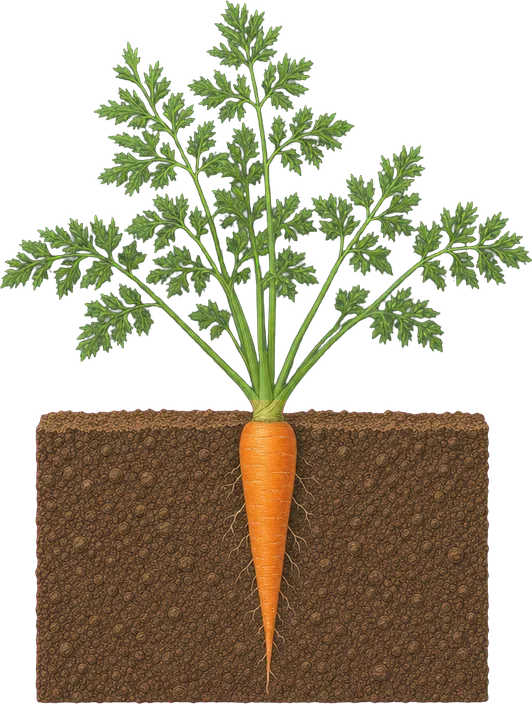
- What you plant
- Seed, sown where it will grow. Moving a carrot damages its taproot.
- When
- Early spring, 2 to 3 weeks before the last frost, once the soil reaches 40 °F; some data waits for 45. Again 10 to 12 weeks before the first frost, for fall.
- How deep
- 1/4 to 1/2 inch. The data runs from 1/8 inch to 3/4.
- How far apart
- 2 to 3 inches apart once thinned; the data runs from 1 to 4. Rows 12 to 18 inches apart, up to 24. The app plants 16 per square foot, 3 inches apart.
- Sun and soil
- Full sun, at least 6 hours. Deep, loose soil that drains, free of stones and clods.
- Frost
- Semi-hardy: a light frost is fine and a hard freeze isn't, and the roots take more cold than the tops.
- Family
- Apiaceae, the carrot family, with parsnip, celery, fennel, parsley, cilantro and dill.
- Harvest
- From 3/4 inch across, 6 to 8 weeks from sowing; past 1 to 1 1/2 inches the core turns woody. Days to harvest run from 50 to 120, by type and place.
- Soil pH
- About 6 to 7; some data aims for 6.0 to 6.5.
- springFirst sowing 2 to 3 weeks before the last frost, the soil at 40 °F.
- summerSow again every 2 to 3 weeks; the first pulling comes 6 to 8 weeks on.
- summerLast sowing for fall, 10 to 12 weeks before the first frost.
- fallA light frost is fine; under mulch, dig until the ground freezes.
Planting#
Sow 2 to 3 weeks before the last frost, in soil of at least 40 °F; some data waits for 45. Seed comes up best at 55 to 65 °F, up to 75 in other data.
Loosen the bed 8 to 9 inches deep, take out the stones and clods, and never work it wet. Fresh manure and woody debris make rough, branched roots; use finished compost.
Sow 1/4 to 1/2 inch deep, 2 or 3 seeds to the inch, mixed with dry sand to spread them. Firm the soil and water gently. The data splits on summer sowings: one source goes to 3/4 inch in dry, warm soil, another never deeper, since the seedling may not make it up.
Keep the surface moist until they're up, 2 to 3 weeks, longer in cold soil: a dry surface or a crust stops them. Water lightly every day or two, or cover the row with vermiculite, sawdust or peat moss. Radish sown in the row marks it and breaks the crust.
Thin them soon after they're up: the data runs from 1 inch tall to 3 or 4, and the roots reach full length within three weeks. Cut the extras off at the soil; some data pulls them. Crowded carrots make all top and no root.
For a steady supply, sow a short row every 2 to 3 weeks; the data runs to every 4. The data stops summer sowings in mid-July. For fall, count back 10 to 12 weeks from the first frost.
In Broadfork On a carrot row, Plant again opens the add form for the same carrot, dated two weeks on, our default interval.
Short season Where the season is short, sow from mid-April, two or three times, three weeks apart. A bed mounded 10 to 12 inches high, rows running north and south, gains a few degrees.
Mild winter Where winters are mild, carrots grow through the cool months, sown from August on through the winter. Pull spring sowings before the heat makes them strong-flavored and fibrous.
The season in between#
Give them at least 1 inch of water a week, and keep it even: drought makes small, tough, bitter roots, and dry then wet splits them. Ease off near harvest, when too much water cracks them.
Water in the morning, at the soil, so the leaves dry and leaf blight stays off.
Go easy on nitrogen, which makes big tops and little root: about 1.5 pounds of 10-10-10 per 100 square feet before planting. Most data side-dresses once, when the tops are about 4 inches tall; one source says carrots don't need it.
Carrots can't shade out weeds, so weed early and shallow: deep hoeing cuts the roots. Once they're up, 3 to 4 inches of weed-free straw or herbicide-free grass clippings holds the water and stops the weeds.
Shoulders that push above the soil turn green and taste off: pull loose soil over them as the roots swell, about 40 to 50 days from sowing.
Roots that finish in hot weather turn pale, strong-flavored and fibrous. Above 85 °F, water well and mulch to cool the soil.
Mild winter Where winters are mild, carrots grow through the dry season, so the watering matters more.
Harvest#
Pull them as soon as they're big enough to use, most at 3/4 inch across, over the next 3 to 4 weeks; some data starts at 1/2 inch. Past 1 to 1 1/2 inches the core turns woody.
Water the day before, then loosen the soil beside the row with a fork before pulling, or the tops break and the roots snap.
Plan on about 1 pound per foot of row: 5 to 10 feet a person fresh, 10 to 15 more to store.
Fall carrots can wait in the ground, and the data splits on how long. Most of it says to cover the soil with thick straw or shredded leaves before the ground freezes and dig all winter on days above freezing; one source lays 6 to 8 inches. A low tunnel keeps the snow off. Another source digs them all before the first moderate freeze. Where carrot rust fly lives, none stay in over winter.
No data gives a date to dig the last of them in spring. Left in, a carrot flowers in its second season.
In Broadfork On a carrot planting still in the ground in fall, the app puts a winter mulch on your list, due before the ground freezes.
Storing#
Cut the tops to within 1/2 inch of the root right away, or they draw the water out of it; the data runs to 1 inch. Keep carrots away from apples, which make them bitter.
Store them near 32 °F in damp air, 90 to 95 percent humidity or 98 to 100 in other data: bagged in the refrigerator, where they taste best within 2 weeks, or in damp sand in a cellar. In ideal storage the data runs from 2 to 4 months to 7 to 9.
The data splits on washing: most of it washes and dries them first, one source leaves them unwashed.
To freeze them, blanch small whole carrots 5 minutes and cut ones 2, cool them in ice water, drain and pack. Can them only in a pressure canner.
Carrots for seed take two seasons: dig the roots in fall, store them at 32 to 45 °F and replant in spring. Save your own seed has the rest.
Which carrots#
Nantes are blunt cylinders 6 to 7 inches long; Danvers taper to a point at up to 7; Chantenay are short and broad, 5 to 6; Imperator is long and slender, 7 to 8; miniature and round types run 2 to 3.
The long types want deep, sandy soil. In heavy or shallow ground, grow Chantenay, Danvers or a round type.
The data splits on containers: one source says no, others grow short types in a pot at least 12 inches deep.
In the app's catalog, among others: Danvers Half Long, Scarlet Nantes, Chantenay Red Core, Little Finger, Thumbelina and Purple Haze.
Short season Where the season is short, the data favors Nantes types, with Nelson and Minicor among the earliest.
What goes wrong#
- Forked, stubby or hairy roots: stones, packed soil, fresh manure, crowding, or too much water or too little.
- Aster yellows: hairy, bitter roots under a bunched top of yellow or reddish leaves. The aster leafhopper brings it in May and June, and nothing cures it: pull sick plants, clear weeds like Queen Anne's lace, and use a row cover.
- Carrot rust fly: rusty tunnels in the root from small white maggots; the tops may yellow and stunt, or show nothing. Cover the row at sowing or sow after mid-June, and pull them all early. No data from the Midwest names it.
- Leaf blight: dark spots with yellow edges, older leaves first, when the leaves stay wet. It rides on seed and old tops, so start with clean seed and turn the tops under. Bolero resists it.
- Root-knot nematodes: forked roots with galls. The data splits on whether moving the carrots each year helps.
- Wireworms and carrot weevils tunnel the roots, and cutworms cut seedlings off at the soil.
- A flower stalk the first year: carrots need a chill to flower, so a sowing made too early can bolt.
Where it goes next year#
Rotate carrots and their family, parsnip, celery, parsley and dill, out of a bed for 3 to 4 years. For leaf blight the data runs from 2 years to 4.
Turn the old tops under or compost them, and pull any carrots left behind: blight and rust fly carry over in them.
Don't sow into fresh sod, where wireworms wait, or within 3 to 4 weeks of turning under a cereal rye cover crop. Keep straw or manure that may carry weed killer off the bed.
Once the bed is empty, cover the soil rather than leave it bare.
In Broadfork The bed's rotation card counts the rest years for you and says which families are clear to go back in.
Every number on this page comes from a published extension source.
Sources for this guide: University of Minnesota Extension, University of Illinois Extension, Texas A&M AgriLife Extension, UMass Extension, University of Maine Cooperative Extension, Utah State University Extension, University of Georgia Extension, Washington State University Extension, Clemson Cooperative Extension, Colorado State University Extension, Iowa State University Extension and Outreach, Ohio State University Extension, Oregon State University Extension, University of Maryland Extension, University of Wisconsin-Madison Division of Extension, Virginia Cooperative Extension, Alabama Cooperative Extension System, Cornell Cooperative Extension, Mississippi State University Extension, National Center for Home Food Preservation, NC State Extension, NDSU Extension, New Mexico State, Purdue Extension, Rutgers NJAES Cooperative Extension, SDSU Extension, University of Alaska Fairbanks, University of California, University of Delaware Cooperative Extension, University of Florida, University of Missouri Extension, University of Nebraska–Lincoln Extension, University of New Hampshire Extension.
The documents behind this guide (70)
- Aster yellows (2023), University of Minnesota Extension
- Bitter taste, University of Minnesota Extension
- Forked or misshaped root, University of Minnesota Extension
- Growing carrots and parsnips in home gardens (2022), University of Minnesota Extension
- Hairy root, University of Minnesota Extension
- Harvesting and storing home garden vegetables (2026), University of Minnesota Extension
- Holes in root, University of Minnesota Extension
- Saving vegetable seeds (2024), University of Minnesota Extension
- Spots on leaves, University of Minnesota Extension
- Carrots, University of Illinois Extension
- Extend Your Growing Season with Low Tunnels (2017), University of Illinois Extension
- Fall Carrots for a Holiday Harvest (2018), University of Illinois Extension
- Keep that Garden Growing (2017), University of Illinois Extension
- Put your garden to bed with fall/winter cover crops! (2021), University of Illinois Extension
- When to Plant (2025), University of Illinois Extension
- Carrots in Texas (2000), Texas A&M AgriLife Extension
- Carrots: Grow, Buy, Store, Use (2020), Texas A&M AgriLife Extension
- Easy Gardening: Mulching (2014), Texas A&M AgriLife Extension
- Texas Home Vegetable Gardening Guide, Texas A&M AgriLife Extension
- Carrot and Parsnip (2013), UMass Extension
- Carrot, Alternaria Leaf Blight (2013), UMass Extension
- Carrots: growing tips (2012), UMass Extension
- Optimal Storage Conditions and Ethylene Sensitivity of Fall Storage Crops (2018), UMass Extension
- Bulletin #2750, An Introduction to Seed Saving for the Home Gardener (2010), University of Maine Cooperative Extension
- How do I store carrots long term in my basement? (2020), University of Maine Cooperative Extension
- Storage Conditions: Fruits and Vegetables (2001), University of Maine Cooperative Extension
- Vegetable Varieties for Maine Gardens (2022), University of Maine Cooperative Extension
- Carrot Rust Fly, Utah State University Extension
- Harvest and Storage, Utah State University Extension
- How to Grow Carrots in Your Garden (2020), Utah State University Extension
- Nematodes, Utah State University Extension
- Fall Vegetable Gardening (2023), University of Georgia Extension
- Homegrown Carrots (2021), University of Georgia Extension
- With a little effort, carrots can be grown in Georgia's clay soil (2014), University of Georgia Extension
- A Step-by-Step Guide to Saving Seeds (seed-library binder) (2024), Washington State University Extension
- Carrot: Carrot rust fly (2025), Washington State University Extension
- Planting Time, it's not a day! (2026), Washington State University Extension
- Carrot, Beet, Radish & Parsnip (2016), Clemson Cooperative Extension
- Planting Depth (inches) (2021), Clemson Cooperative Extension
- Freezing Carrots, Colorado State University Extension
- Saving Seed, Fact Sheet 7.602 (2025), Colorado State University Extension
- Growing Carrots and Parsnips (2023), Iowa State University Extension and Outreach
- What are some good carrot varieties for Iowa? (2024), Iowa State University Extension and Outreach
- Cover crops in the garden (2023), Ohio State University Extension
- Selecting, Storing and Serving Ohio Carrots (2021), Ohio State University Extension
- Carrots (2021), Oregon State University Extension
- Collecting and storing seeds from your garden (Mansour, Hatch), May 2003, reviewed 2024 (2024), Oregon State University Extension
- Deformed Root Crop Vegetables (2023), University of Maryland Extension
- Growing Carrots in a Home Garden (2023), University of Maryland Extension
- Aster Leafhopper (2026), University of Wisconsin-Madison Division of Extension
- Carrot Alternaria and Cercospora Leaf Blights (2026), University of Wisconsin-Madison Division of Extension
- Mulching: Purpose, Benefits, and Essential Information (2025), Virginia Cooperative Extension
- Root Crops (2026), Virginia Cooperative Extension
- Vegetable Seasons in Alabama (2025), Alabama Cooperative Extension System
- Carrot Leaf Blight Diseases and their Management (2021), Cornell Cooperative Extension
- Nematode Control in the Home Garden, Mississippi State University Extension
- Freezing Carrots (2014), National Center for Home Food Preservation
- Vegetable Gardening: A Beginner's Guide (2023), NC State Extension
- Field to Fork: Carrots (2026), NDSU Extension
- Vegetable Seed Saving for Home Gardeners and Small-scale Farmers, Guide H-262 (Walker, Garvin, Tonnessen, Joukhadar), July 2022 (2022), New Mexico State
- Home Gardener's Guide (2026), Purdue Extension
- Carrot Rust Fly in the Home Garden (2026), Rutgers NJAES Cooperative Extension
- Carrots: How to Grow It (2024), SDSU Extension
- Growing Carrots in Alaska (2024), University of Alaska Fairbanks
- Saving Seeds, University of California
- Carrots (2024), University of Delaware Cooperative Extension
- Carrots, University of Florida
- Planning and planting guides (2017), University of Missouri Extension
- Vegetable Garden Seed Storage and Germination Requirements, G2090 (2011), University of Nebraska–Lincoln Extension
- Fall Vegetable Garden Activities (2000), University of New Hampshire Extension
Updated 11/11/2026 · Checked against our sources 11/12/2026