
Crop guide
Strawberries
Strawberries go in as plants in early spring, as soon as the soil can be worked. Pick off the first summer's flowers, and a June-bearing bed gives its first real crop the next year.
Grown in Ohio, zone 6a. Your frost dates move the calendar; the signals don't. Broadfork goes by where your garden is, not its zone: frost dates for your ZIP code in the US, or the ones you type in anywhere else.
Nine minutes to read. Each section stands on its own.
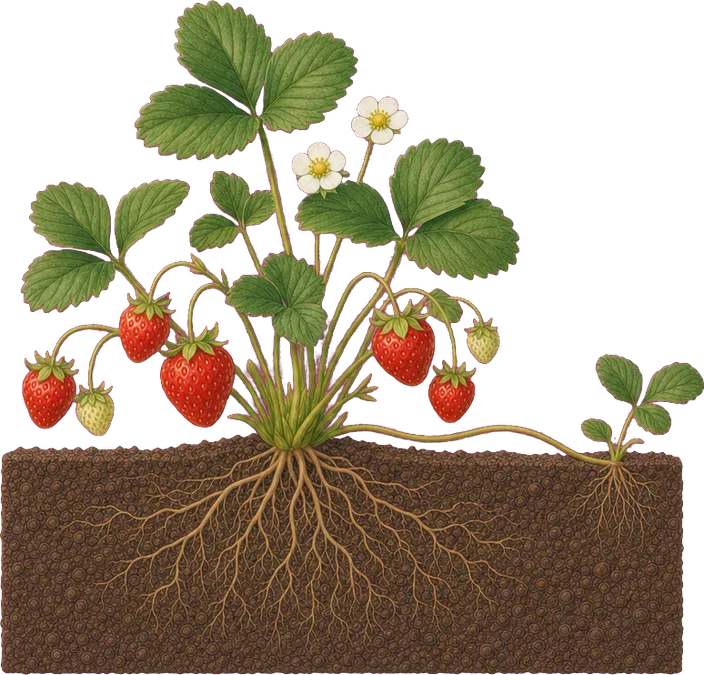
- What you plant
- Plants, not seed: dormant bare-root crowns, or potted plants. Buy new, disease-free ones, not runners from an old bed.
- When
- Early spring, once the soil is dry enough to work; one source says never after June 1. Not in fall where winters freeze: freezing and thawing heave young plants out.
- How deep
- Set by the crown: from half of it buried to only its base covered, the growing point above.
- How far apart
- June-bearers 12 to 24 inches apart in rows 36 to 40 inches apart; day-neutrals 8 to 12 inches, in rows 30 to 36. The app plants 4 per square foot, 6 inches apart.
- Sun and soil
- Full sun, at least 6 hours and ideally 10 or more. Loose, fertile soil with organic matter that drains well.
- Frost
- Hardy. The danger is frost at bloom: an open blossom is damaged at 30 °F.
- Family
- Rosaceae, the rose family.
- Harvest
- Fully red, caps on, about 28 to 30 days after full bloom.
- Soil pH
- 5.8 to 6.5; the data runs from 5.5 to 7.5.
- springBloom: an open blossom is damaged at 30 °F.
- springRipe 28 to 30 days after full bloom; the picking runs 3 to 4 weeks.
- summerRenovate right after it, and feed again in mid-August.
- summerNext year's flower buds form from late August into fall: keep the water up.
Planting#
Plant in early spring. Keep bare-root plants cool and moist until then, and soak the roots about 30 minutes first. Plant 25 for an average family.
Clear the perennial weeds a year ahead: strawberries compete poorly. A gentle slope or higher ground drains the cold air away from spring blossoms.
Skip ground that was lawn lately: white grubs come with it, and one source waits two years. Skip ground where tomatoes, potatoes, peppers or eggplant grew, since the verticillium wilt they carry lasts 25 years or longer in the soil. The data waits from 2 or 3 years to 5.
Spread the roots, cover them, firm the soil and water the plant in. The crown is where the data splits three ways: half of it buried, set at the soil line, or only its base covered. Too deep, it rots; too shallow, it dries.
Set June-bearers 12 to 24 inches apart in a matted row; their runners root to fill a row 18 to 24 inches wide by August, 6 to 8 inches apart, close to the app's 4 per square foot, 6 inches apart. Day-neutrals and everbearers go in hills, 8 to 12 inches apart, every runner cut.
Short season Where the season is short, dormant plants go in during April or May. One source allows a late-summer planting, before August 15.
Mild winter Where winters are mild, strawberries are often annuals: plugs set from about September 15 to November 15, and pulled after the spring crop.
The first year#
Pick off the first year's flowers so the plant builds roots and runners. On June-bearers, most data takes every flower stalk all season; one source takes them only for the first few weeks, then lets the plants fruit that summer.
Day-neutrals and everbearers fruit the first year, so their flowers come off only for a while. One source gives two rules: until about mid-June, or the first 6 weeks after planting. Others run from 4 weeks to the end of July.
Runners start within 4 to 5 weeks. In a matted row, press the tips you want into the soil to root, and cut the rest.
Water 1 to 1.5 inches a week from mid-June to mid-August, at the soil, early in the day. Mulch day-neutrals with 3 to 4 inches of straw.
Feed a new bed 7 to 10 days after planting with 10 ounces of 10-10-10 per 100 square feet, and again in mid-August.
Short season Where the season is short and day-neutrals are grown as annuals, one source leaves the early flowers on: taking them cuts the yield.
Each spring#
Don't feed June-bearers in spring. Most data says spring nitrogen means soft berries and dense leaves where gray mold takes hold; feed after the harvest instead.
Mild winter Where winters are mild, the data feeds June-bearers in late winter, as growth begins.
A row cover over the bed in late winter brings the bloom on sooner. Take it off just before the flowers open, so the bees reach them.
Frost at bloom is what costs a crop. An open blossom is damaged at 30 °F. A tight bud takes more cold: the data says down to 20 °F; some says only 25. Early varieties bloom first and risk most. A frosted flower gives a small, misshapen berry.
When frost is forecast, cover the plants the afternoon before. A light row cover adds 2 to 3 degrees, but frost gets the blossoms wherever it touches them, so tent it.
Harvest#
Pick them fully red: they don't ripen after picking. Pinch the stem about 1/4 inch above the cap rather than pulling. Pick in the morning once the plants are dry.
Pick every day or every other day, every 3 to 4 days in cool weather. A June-bearer's picking runs 3 to 4 weeks.
Refrigerate them unwashed, caps on: 5 to 7 days at 32 °F; the data runs from 3 days to a week. To freeze, stir 3/4 cup of sugar into each quart.
Mild winter Where winters are mild, the data picks them at three-fourths red.
After harvest#
Renovate June-bearers every year, right after the last picking and before August: it thins the crowded bed and takes away the old leaves that carry disease. Day-neutrals and everbearers aren't renovated.
- Pull the weeds, then mow off the old leaves with the blade set high to spare the crowns, and rake them away.
- Narrow the rows to about 12 inches; the data runs from 6 to 18. Thin the plants to 4 to 6 inches apart.
- Cover the crowns with 0.5 to 1 inch of soil, and spread 2.5 pounds of 10-10-10 per 100 square feet.
- Water 1 inch a week when it doesn't rain, through September.
Feed again in mid-August, and water from late August into early October, while next year's flower buds form.
Once the plants go dormant in late fall, the bed goes under straw: the winter mulch guide has when, how deep and when it comes off.
Which strawberry#
June-bearers set their buds in the short days of fall and give one big crop the next spring, for jam, the freezer or sharing. Everbearers give two smaller crops, late spring and early fall. Day-neutrals bear in flushes from summer to frost, pausing in the heat, at more work.
Some data sorts the everbearers in with the day-neutrals; some keeps them apart.
Where red stele or verticillium wilt has been, grow a variety that resists both, such as Allstar, Earliglow, Guardian or Surecrop. Jewel and Kent resist neither.
In the app's catalog, among others: Earliglow, Honeoye, Jewel, Allstar, Seascape and Albion.
In Broadfork On an Albion, Seascape, Tribute or Tristar planting, the Timeline leaves a gap in the picking where your summer is likely to pass 85 °F; the restart is the app's own estimate.
Short season Where winters are hard, most day-neutrals won't come through, so they're grown as annuals. June-bearers winter best.
Mild winter Where winters are mild, the annual crop is Chandler, Camarosa or Sweet Charlie; most everbearers are northern and do poorly in the heat.
What goes wrong#
- Gray mold: soft brown spots that grow a gray dust, worst in wet weather. Most of it gets in at bloom. Give the bed air and straw under the fruit, pick often, and take off moldy berries.
- Leaf spot and leaf scorch: purple spots or blotches on the leaves. Grow a resistant variety, and clear the old leaves at renovation.
- Red stele: plants in low, wet spots stunt, then wilt in the first hot spell, the root's core red inside. It lasts 13 years or longer in the soil. On heavy ground, raise the bed at least 10 inches.
- Verticillium wilt and black root rot: outer leaves wilting brown, or weak plants with black roots. Neither can be treated at home: plant clean stock on drained ground, and move the bed.
- Tarnished plant bug: misshapen berries from feeding at bloom. Shake the plants over a white sheet from green bud through bloom, and keep the weeds down.
- Sap beetles and slugs: deep holes in ripe berries. Pick on time, and clear overripe and damaged fruit as you go.
- Birds: holes in ripe berries, or berries gone. Net the bed, anchored all the way around or the birds walk under, and pick as soon as they're ripe.
In Broadfork Bird netting over a strawberry planting goes on your list a week before its first berries are expected; log Flowering and the app counts them 28 days from that day. The week is the app's own lead.
A new bed#
A bed gives its best for about three harvests, and a new one goes in after 3 or 4 years of fruit; the data runs from 2 years to at least 5. A weedy or sick bed goes sooner.
Start it on fresh ground, out of strawberries for at least 2 to 4 years, with new nursery plants, not runners from the old bed. Where red stele or wilt struck, the ground doesn't go back to strawberries.
Short season Where the season is short, one source keeps a bed only two seasons.
Mild winter Where winters are mild, a kept bed is replaced every 2 to 3 years.
In Broadfork A June-bearing planting's details count its years, from year 1 establishing, with the advice to strip the flowers, to declining from year 4, its Timeline bar drawn less solid.
Every number on this page comes from a published extension source.
Sources for this guide: Ohio State University Extension, Iowa State University Extension and Outreach, University of Minnesota Extension, Penn State Extension, UMass Extension, University of Georgia Extension, Utah State University Extension, Clemson Cooperative Extension, National Center for Home Food Preservation, NC State Extension, NDSU Extension, Purdue Extension, SDSU Extension, University of Alaska Fairbanks, University of Arizona Cooperative Extension, University of Florida, University of Illinois Extension, University of Maryland Extension, University of Nebraska–Lincoln Extension, University of Wisconsin-Madison Division of Extension.
The documents behind this guide (47)
- Angular Leaf Spot of Strawberry (Bacterial Blight) (2011), Ohio State University Extension
- Anthracnose of Strawberry (2016), Ohio State University Extension
- Black Root Rot of Strawberry (2016), Ohio State University Extension
- Gray Mold (2016), Ohio State University Extension
- Growing Strawberries in the Home Garden (2017), Ohio State University Extension
- Neopestalotiopsis Disease of Strawberry (2026), Ohio State University Extension
- Phomopsis Leaf Blight and Fruit Rot of Strawberry (2016), Ohio State University Extension
- Red Stele Root Rot of Strawberry (2016), Ohio State University Extension
- Strawberry Leaf Diseases (2016), Ohio State University Extension
- Verticillium Wilt of Strawberry (2016), Ohio State University Extension
- Getting Ahead with Fall Strawberries (2022), Iowa State University Extension and Outreach
- Harvesting and Storing Small Fruit (2025), Iowa State University Extension and Outreach
- How long can I expect my June-bearing strawberry planting to be productive? (2022), Iowa State University Extension and Outreach
- Pests in the Home Strawberry Patch (2016), Iowa State University Extension and Outreach
- Planting, Growing and Maintaining Strawberries (2016), Iowa State University Extension and Outreach
- Renovation of June Bearing Strawberries (2023), Iowa State University Extension and Outreach
- There are small, black, yellow-spotted beetles feeding on my strawberries. What should I do? (2022), Iowa State University Extension and Outreach
- Understanding Strawberry Types for the Home Garden (2026), Iowa State University Extension and Outreach
- What would be a good strawberry variety for the home garden? (2026), Iowa State University Extension and Outreach
- Choosing a strawberry production system (2021), University of Minnesota Extension
- Growing strawberries in the home garden (2024), University of Minnesota Extension
- Protect strawberries from spring freeze and frost (2021), University of Minnesota Extension
- Renovate your strawberries to prepare for next year (2023), University of Minnesota Extension
- Sap beetles in home gardens (2021), University of Minnesota Extension
- Strawberry diseases in Minnesota (2021), University of Minnesota Extension
- Strawberry insect pests in Minnesota (2021), University of Minnesota Extension
- Growing Strawberries (2026), Penn State Extension
- Powdery Mildew of Strawberries in Home Fruit Plantings (2026), Penn State Extension
- Strawberry IPM: Gray Mold (2015), UMass Extension
- Strawberry IPM: Verticillium Wilt (2020), UMass Extension
- Home Garden Strawberries (2022), University of Georgia Extension
- Propagating Deciduous Fruit Plants Common to Georgia (2026), University of Georgia Extension
- Harvest and Storage of Vegetables and Fruits (2015), Utah State University Extension
- How to Grow Strawberries in Your Garden (2008), Utah State University Extension
- Growing Strawberries in South Carolina (2025), Clemson Cooperative Extension
- Freezing Strawberries (2014), National Center for Home Food Preservation
- Chapter 14, Small Fruits, NC State Extension
- Strawberries (2023), NDSU Extension
- Growing Strawberries (2026), Purdue Extension
- Strawberry Care (2019), SDSU Extension
- Growing Annual Strawberries in Alaska (2022), University of Alaska Fairbanks
- Growing Strawberries in Home Gardens (2015), University of Arizona Cooperative Extension
- Strawberries, University of Florida
- Growing Strawberries, University of Illinois Extension
- Growing Strawberries in a Home Garden (2026), University of Maryland Extension
- Renovation of Strawberry Plantings (2022), University of Nebraska–Lincoln Extension
- White grubs: pests of strawberry roots and foliage (2019), University of Wisconsin-Madison Division of Extension
Updated 11/10/2026 · Checked against our sources 11/12/2026